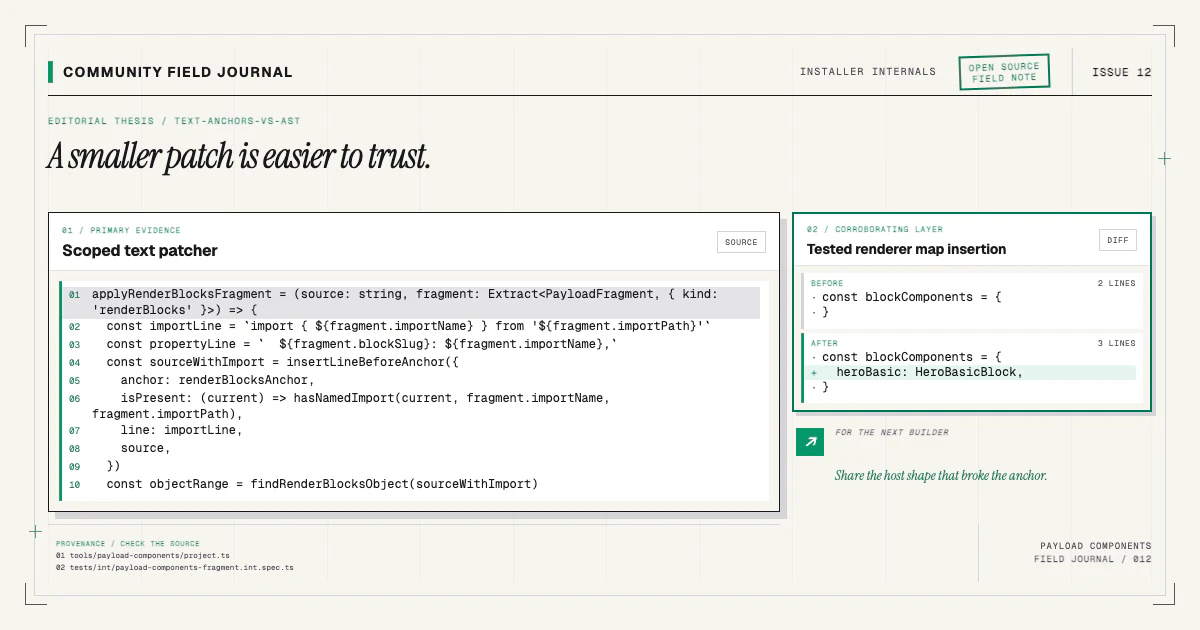
Editing someone else's TypeScript is the riskiest part of a source installer. An abstract syntax tree sounds like the principled tool: parse the file, find a node, mutate it, print the tree. For Payload Components, I chose narrower text anchors instead. The decision is not that text is universally better. It is that our supported edits are small, the host shape is explicit, and diff quality is a core product constraint.
A text-anchor patch can add one import or one object entry without reprinting the surrounding file. When its assumptions fail, it stops. That gives up broad compatibility in exchange for legible changes and failure modes a contributor can reproduce.
The actual edits are constrained
Installing a page block into the supported starter requires a known set of changes:
- import the block config into the Pages collection;
- add the config to the
layoutBlocks field; - import the React component into RenderBlocks;
- add a
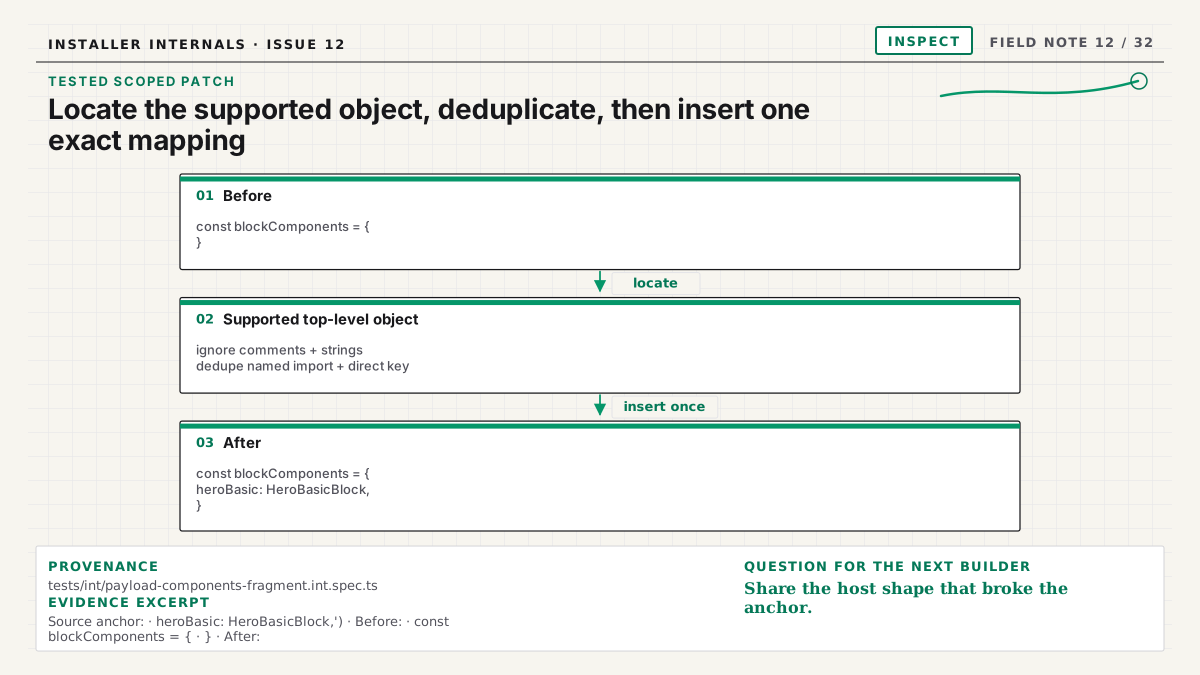
blockTypekey toblockComponents.
These are insertions around stable, documented anchors. The CLI does not rename variables, reorganize imports, infer business logic, or refactor arbitrary expressions. A full compiler transformation is more power than the operation needs.
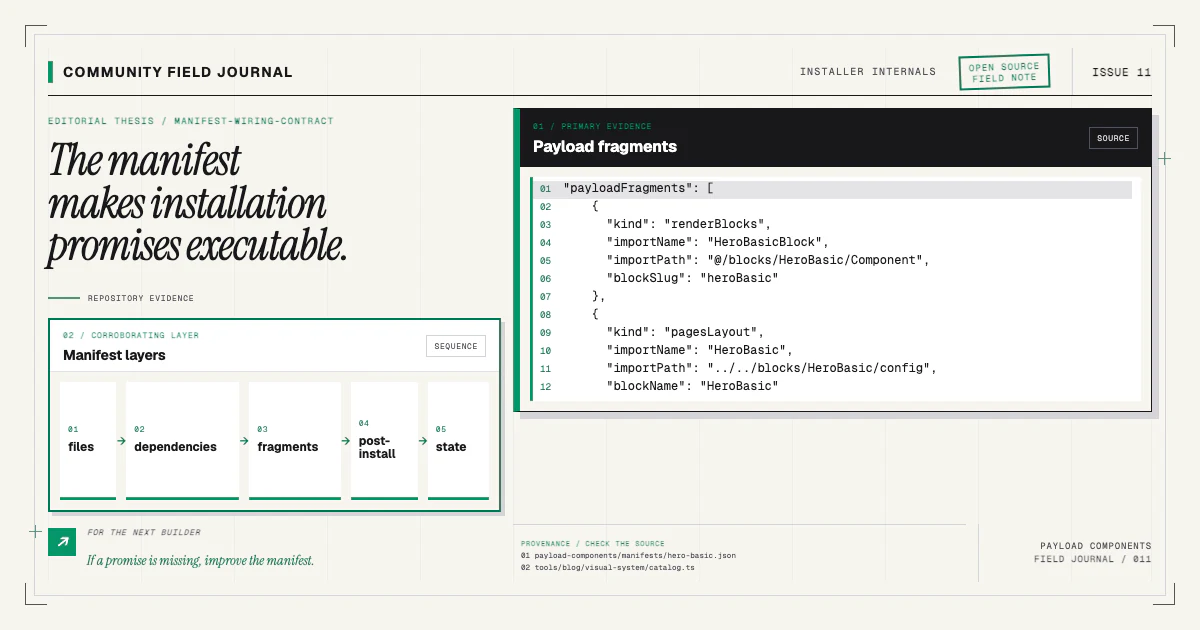
The manifest article shows how each insertion is declared alongside owned files and generators.
AST printing can create a larger diff than the change
Parsing is usually precise; printing is where ownership becomes complicated. A code generator must decide quote style, semicolons, line wrapping, import grouping, comments, trailing commas, and syntax it may not preserve exactly. Even when a printer is correct, it can reformat an entire file around a two-line edit.
That noise makes review harder. The consumer needs to distinguish installer intent from formatting churn. A narrow patch preserves every unrelated byte, so the diff shows the new import and registration rather than a tool's opinion about the file.
An AST approach can minimize printing with source ranges or specialized mutation libraries, but then the implementation becomes a hybrid source editor with its own comment and whitespace edge cases. That investment is justified when transformations are complex or host shapes are broad. It is not automatically safer for four insertions.
Anchors make support boundaries explicit
Text patches work only when the expected source exists. The renderer anchor
const blockComponents = { and collection anchor name: 'layout' intentionally describe the
supported starter. If a repository uses a switch statement, generated renderer, renamed field, or
factory function, the installer should not pretend it understands the structure.
Project detection runs before mutation. Fragment application verifies the expected anchor and its
deduplication evidence. A missing anchor produces an actionable failure in fragment-apply. The
consumer can integrate manually, adapt the repository, or contribute a tested supported shape.
That is a better open-source contract than “works on any Payload app” followed by speculative edits. The installation docs describe the expected architecture so the boundary is visible before someone runs the command.
Deduplication is designed with the insertion
Every fragment has a corresponding already-applied check. For an import, the check looks for the specific module and binding. For an array or map entry, it looks for the exact registration. On a rerun, existing work is skipped.
Dedup checks cannot be a loose search for HeroBasic; that name might appear in a comment or a
different scope. The evidence should be as specific as the insertion. Integration tests apply the
install twice and assert the second pass does not duplicate text.
If files are formatted after the first install, checks still need to recognize the supported formatting variants or compare semantic enough text. This is where a narrowly scoped tokenizer can be useful without adopting whole-file AST printing. The right tool can vary per fragment.
Sequential patches stay recoverable
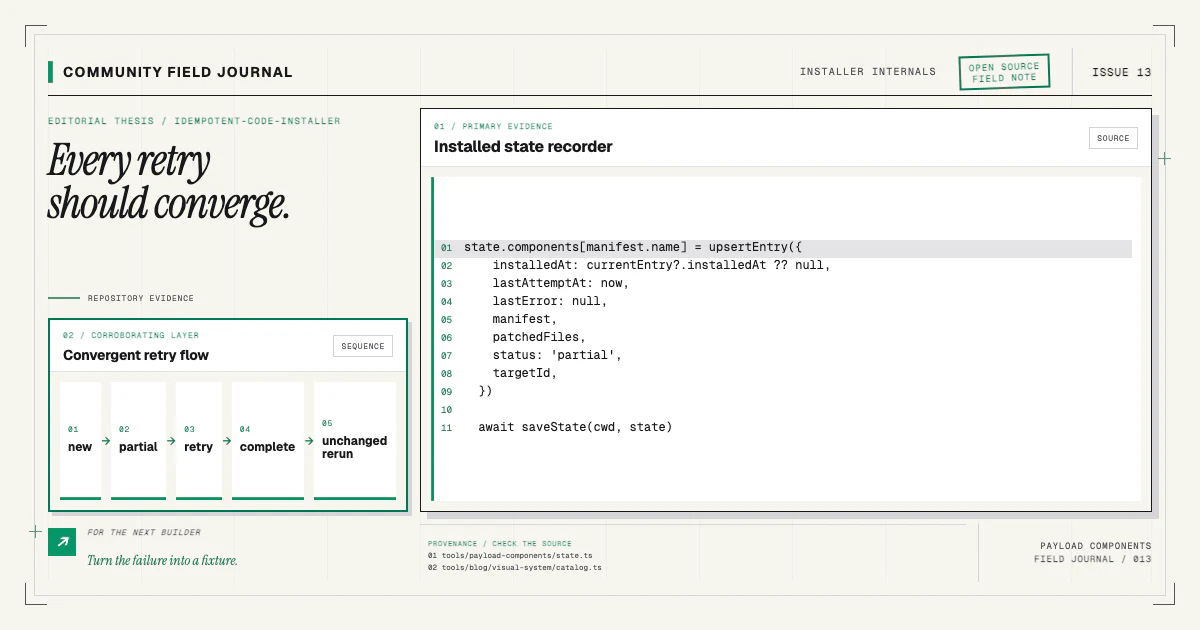
Fragment files are read and patched sequentially. Each missing anchor fails that file without a
broad rewrite, but a later missing anchor can fail after an earlier host file changed. Before
execution begins, the CLI records a partial attempt. If a later operation fails, lastError records
that failed stage and message so the partial install remains diagnosable.
Each supported insertion is intentionally narrow, so multi-file application is recoverable, not globally prevalidated or atomic. That is why install state and idempotent recovery exist. The idempotency guide covers the larger convergence model.
Git is an important safety layer too. The normal workflow is a clean branch and a reviewable diff. The CLI should never use git as permission to be careless, but source control gives the consumer a familiar way to inspect or discard the complete operation.
When an AST would be the better choice
I would revisit the decision if the installer needed to:
- support many equivalent renderer syntaxes;
- modify nested expressions whose location cannot be anchored reliably;
- preserve imports while resolving aliases and namespace bindings semantically;
- migrate existing schemas rather than insert new members;
- analyze scope to avoid identifier collisions;
- provide automated updates across substantially changed files.
At that point, a TypeScript-aware transformation with careful source preservation may reduce risk. The cost should be paid because the supported behavior requires it, not because an AST sounds more sophisticated.
Conversely, a regex is not enough for every text task. The current patcher uses explicit anchors, dedup evidence, validation, and integration fixtures. “Text-based” should not mean “global replace the first brace.” The design is conservative source editing.
Diff quality is part of correctness
An installer can produce compiling code and still fail its human contract. If it rewrites unrelated imports, removes comments, changes formatting across hundreds of lines, or hides the new map key in churn, the result is harder to trust and maintain.
This project treats the git diff as an output. Tests assert the expected host fragments. Docs state what the install edits. A consumer should be able to read the result without understanding the installer implementation.
Try a representative install on a clean branch:
npx payload-components add hero-basicInspect the Pages and RenderBlocks diffs. Then rerun the command and confirm they remain unchanged. If a common supported starter version has moved an anchor, bring a minimal fixture and the narrow diff you expect. Updating detection, fragment metadata, tests, and the architecture docs together is the durable way to expand support.