An idempotent installer makes the same request safe to repeat. For source installation, that means more than “the second command exits zero.” Files should not duplicate, imports should not multiply, array entries should remain singular, dependencies should stay stable, generators should be safe to rerun, and recorded state should converge on one truthful result.
This matters most when something fails. Networks, package managers, generators, and consumer code can all interrupt an install after partial progress. A retry should use evidence from the repository and state record, not ask the user to reconstruct the earlier attempt from memory.
Define the desired state first
For a component, the desired state includes:
- every owned source file exists at the declared target;
- required packages and public registry dependencies are present;
- every collection and renderer fragment appears exactly once;
- generated Payload artifacts reflect the final config;
- install state records the contract identity, result, timestamps, error, and patched host files.
Each stage needs a check that can distinguish complete, incomplete, conflicting, and not started. “Run this command again” is not a design until those observations are defined.
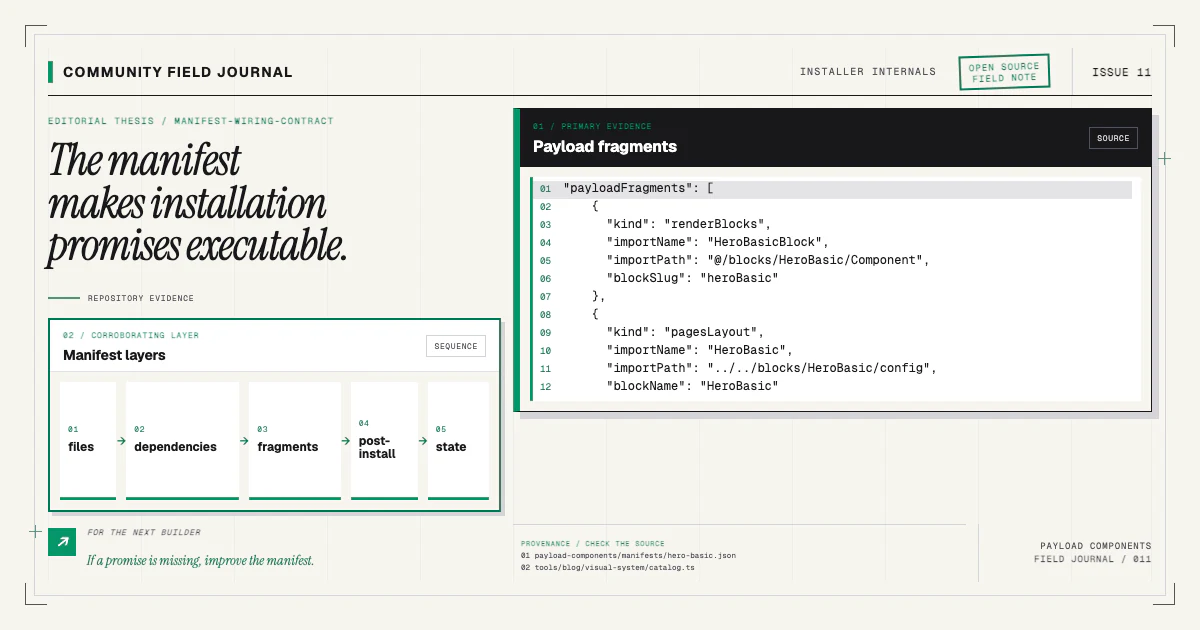
The manifest contract provides the declarative inputs. The installer turns them into stage-specific checks and mutations.
Make stages independently repeatable
The add pipeline separates registry build, source delivery, dependency installation, fragment
application, and post-install generation. A stage should either discover its result already exists
or move the repository toward that result.
File delivery can compare the requested registry item and target paths. Dependency installation can read the package manifest and lockfile behavior. Fragment application has explicit dedup checks. Generators are expected to derive output from the same final config each time.
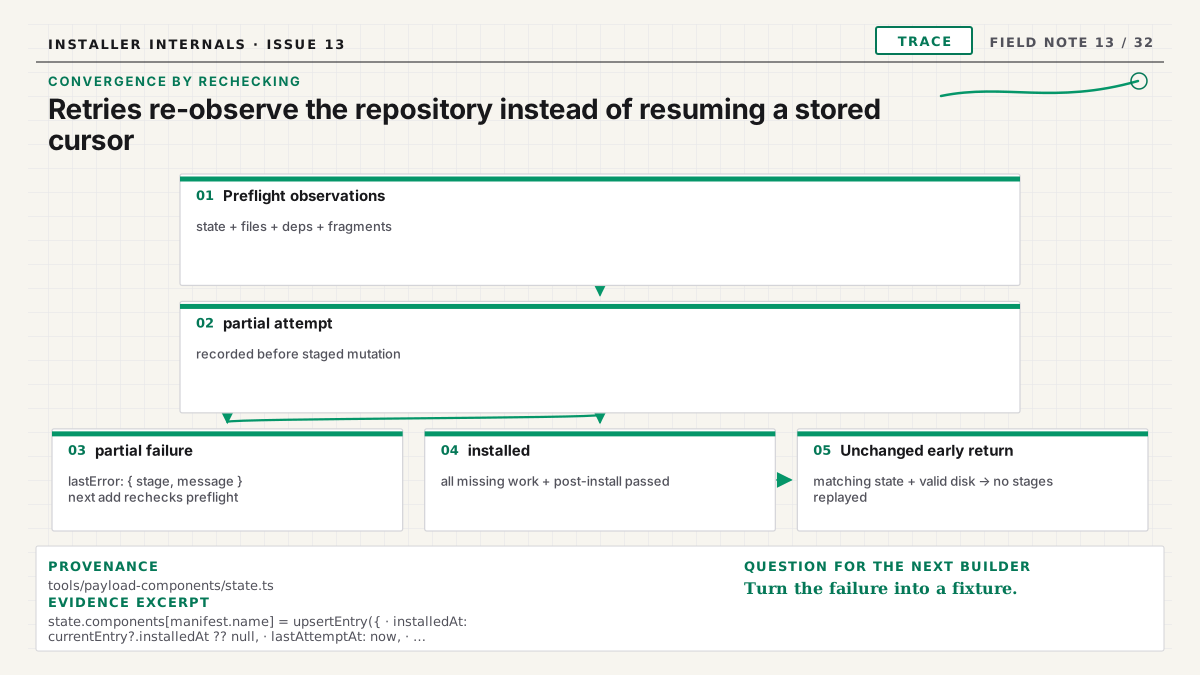
This separation makes failure messages precise. “Failed during dependency-install” tells the user which operation threw. It does not tell a later run to jump past earlier operations: the retry rechecks files, dependencies, and fragments from the repository before deciding what to run.
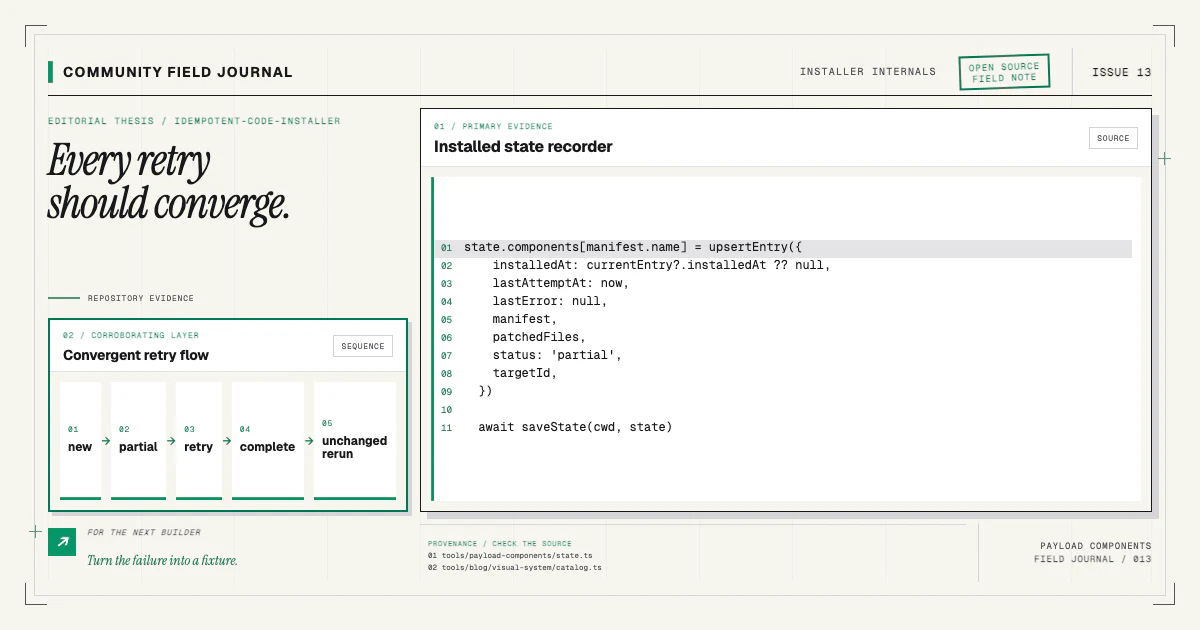
The CLI records a partial attempt before mutation begins. If an operation throws, it writes the
failed operation and message to lastError; it records installed only after every required
operation and post-install script succeeds.
Treat partial installation as a first-class state
Rollback is attractive but often dishonest for source installers. Once a package manager changes a lockfile or a generator rewrites project-wide output, reconstructing the exact prior repository can be riskier than preserving the partial diff for review. Git can discard the branch if the user wants a full rollback.
The installer records a partial outcome with the last failed stage and its message. It prints the
safest retry: fix the underlying command, then run the same add request. doctor can compare state
with current files before that retry.
A partial state should never be reported as installed. It should also not strand the user. The next run recognizes the component, explains that it is retrying a partial installation, rechecks prior work, and continues.
Deduplicate host edits semantically enough
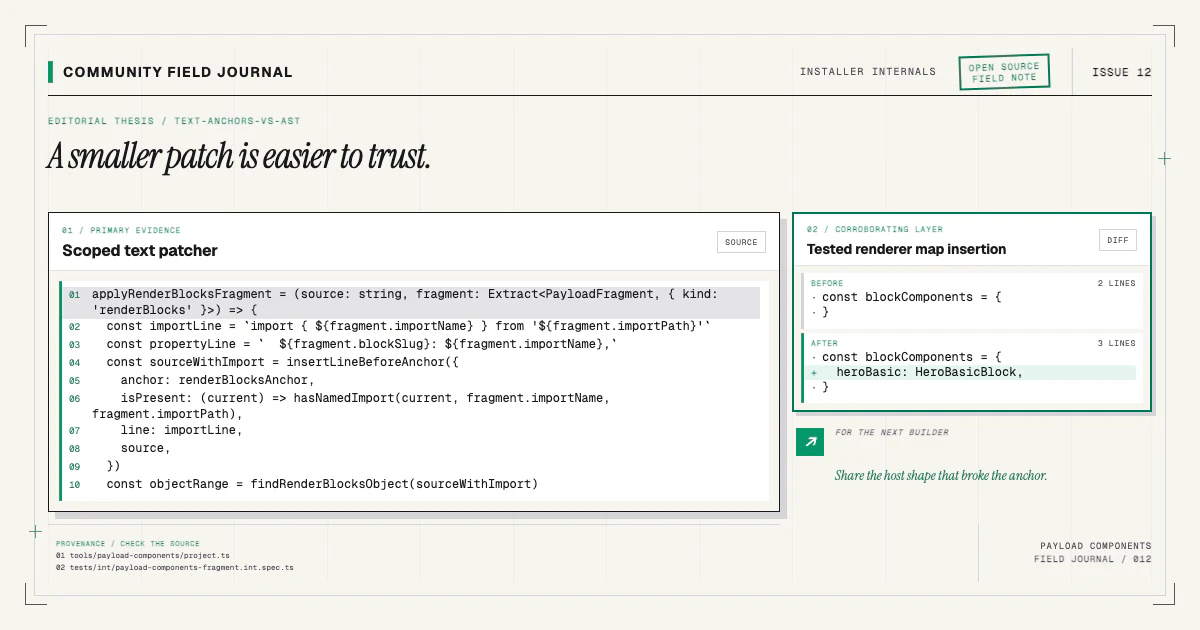
Source fragments are the easiest place to violate idempotency. Before inserting an import, confirm the specific binding and module do not already exist. Before adding a block to an array, confirm the registration is absent. Before adding a renderer key, confirm that key is not already mapped.
The current check looks for the exact supported named import and direct map entry. It does not treat
a loose mention of heroBasic as proof that the expected renderer mapping exists, and it does not
infer equivalence from a custom mapping. Reconcile a customized host shape deliberately and inspect
the resulting diff.
The text-anchor design article explains why these checks stay close to small, explicit insertions.
Respect manual edits to owned source
Idempotency is not permission to restore component files to a canonical copy on every run. Once source lands, the consumer may edit it. A repeated add should report that the component is already installed rather than overwrite local work.
An update workflow requires a different contract: identify the installed version, detect local changes, compute a proposed merge, and ask the user to review it. Conflating add and update makes a simple rerun destructive.
Likewise, a missing owned file can be an accidental deletion or a deliberate local removal.
doctor should report the discrepancy and recommend a clear action. Automatic recreation may be
appropriate only through an explicit repair or reinstall operation with documented consequences.
Make dependencies stable
Package managers are generally idempotent for an already-declared dependency, but an installer still needs to avoid version churn. Use manifest declarations consistently, detect the consumer's package manager, and do not rewrite unrelated dependency ranges.
If installation fails because a peer dependency conflicts, record the stage and surface the package manager's error. Do not force flags that weaken the consumer's dependency contract. The user can resolve the version intentionally and retry.
Lockfile changes belong in the reviewable diff. A no-op rerun should leave the package manifest and lockfile unchanged.
Verify generators converge
Payload type and import-map generation should be deterministic for a stable config and toolchain. Running them twice should not create alternating formatting or ordering. If generated output churns, the installation cannot be cleanly idempotent even when source fragments are perfect.
Pin dependencies through the lockfile, run generation from the same project root and environment, and add a clean-tree check where generated artifacts are committed. The article on Payload's generated contracts covers the operational choices.
If a generator fails, preserve its output and error for diagnosis. State should show that fragment
application may already be present on disk while lastError.stage identifies post-install.
Test transitions, not only happy paths
An idempotency suite needs more than “run twice.” Useful cases include:
- Fresh install reaches complete state.
- Complete install reruns without source duplication or diff.
- Failure during dependencies records partial state.
- Retry after the failure reaches the intended repository result.
- Missing fragment is diagnosed after recorded success.
- Exact fragment rerun does not duplicate the named import or direct map entry.
- Missing anchor fails without a broad rewrite.
- Missing owned file produces a specific integrity report.
- Generator failure remains recoverable.
Fixtures should inspect file content and state, not only stdout. A successful exit can still leave duplicate imports. A helpful message can still describe the wrong stage.
Give recovery a read-only command
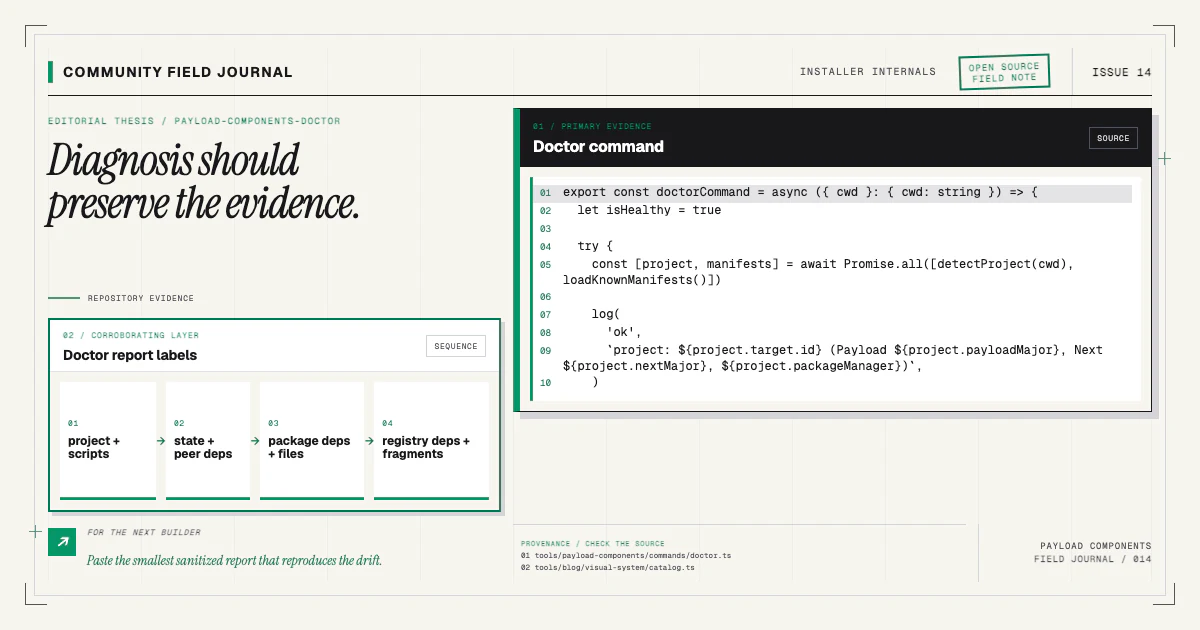
payload-components doctor checks project readiness and recorded installs without modifying the
repository. Read-only diagnosis matters because a user investigating an uncertain state should not
trigger more changes merely by asking what is wrong.
The command classifies healthy, warning, and error conditions, then prints exact retry guidance. The doctor guide shows representative reports and what evidence each check uses.
Try the convergence behavior on a disposable branch:
npx payload-components add hero-basic
npx payload-components add hero-basic
npx payload-components doctor
The second add should report the existing installation, and doctor should report a healthy record. If a rerun changes a file, capture the before-and-after diff and open an issue against the installation contract. Repeated real-world installs are the best way to expose an assumption that unit fixtures have not yet learned.