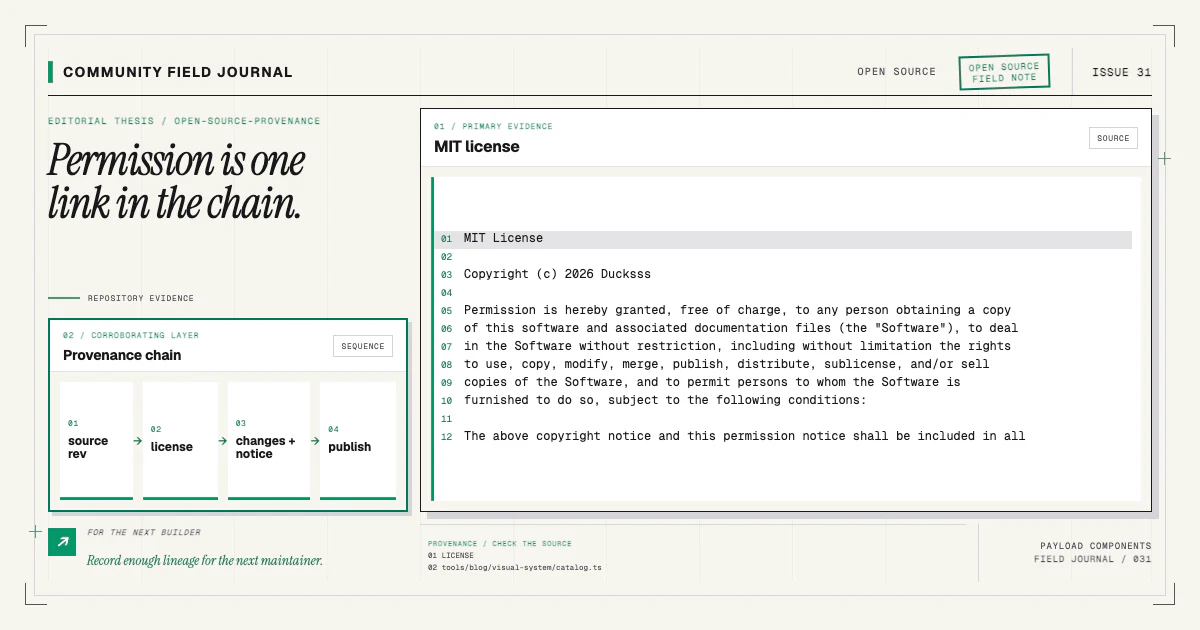
A license answers whether and how source may be used. Provenance answers where the work came from, which version was used, what changed, and which notices must travel with the adaptation. A repository can contain an MIT file and still lose the history of copied components, icons, illustrations, fonts, or snippets.
For a source registry, that history matters twice. Maintainers need it to honor upstream work and review future updates. Consumers receive copied files and need the notices or context required by the original license.
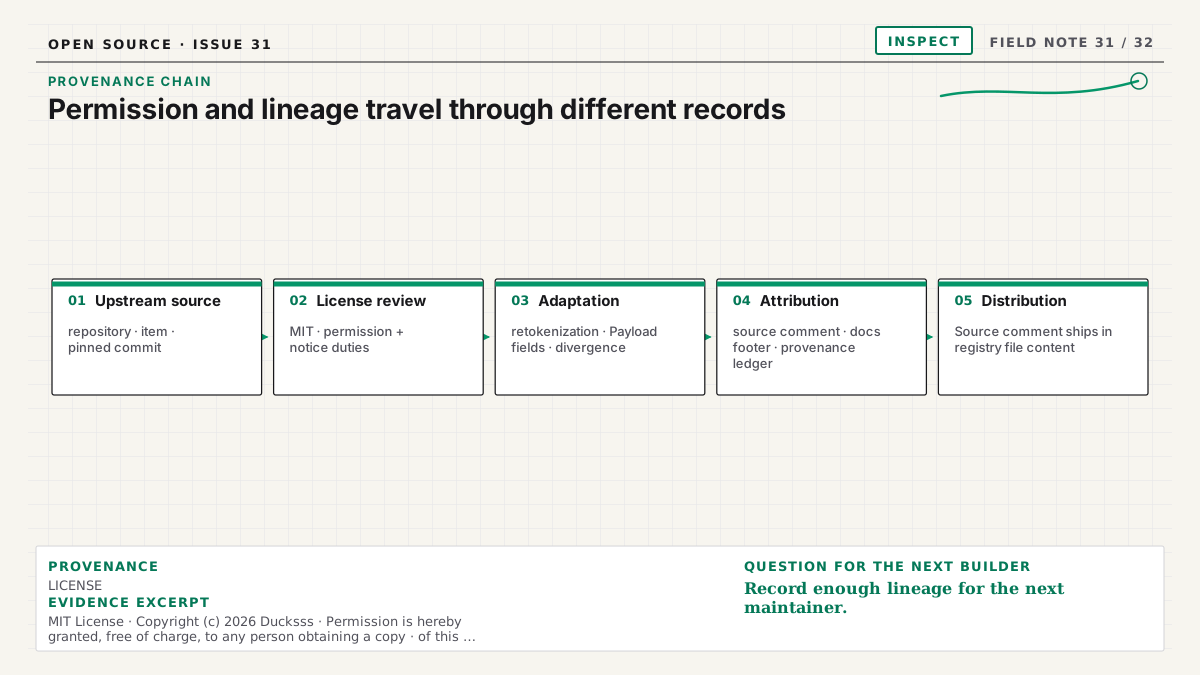
Record the exact upstream source
“Inspired by a component online” is not enough. Record the project name, canonical repository URL, author or organization, exact commit or release, source path, and retrieval date. If the work came from a published package, record its version and package location.
Exact versions make later comparison possible. A repository homepage can change; a commit preserves the source you actually evaluated. Keep this record in a discoverable provenance or notice file near the adapted work and in the pull request rationale.
Screenshots are not source. If a design was independently implemented from a visual reference, say that accurately and record the reference according to repository policy. Do not imply code lineage that did not occur, or hide lineage that did.
Read the applicable license
Confirm the license covers the specific code or asset. Repositories can contain subdirectories, examples, fonts, or media under different terms. A homepage badge is not a substitute for the actual license text and notices in the source tree.
Understand attribution, notice preservation, source distribution, trademark, patent, and copyleft obligations relevant to the work and distribution method. This article is an engineering workflow, not legal advice; ask qualified counsel when terms or use are unclear.
If the license is absent or incompatible with the repository's MIT distribution, do not copy the work. Reimplementing from requirements may still involve other rights and should be considered carefully rather than treated as a loophole.
Describe the adaptation
Record what changed: TypeScript conversion, Payload field model, responsive behavior, token mapping, accessibility fixes, removed dependencies, or new tests. This respects the upstream contribution and helps maintainers decide whether a future upstream patch still applies.
A concise adaptation note can link to the local source and upstream commit. Avoid claiming upstream authors endorse the fork or local project. Keep project trademarks and logos out of generated cover art and promotional claims unless usage is permitted.
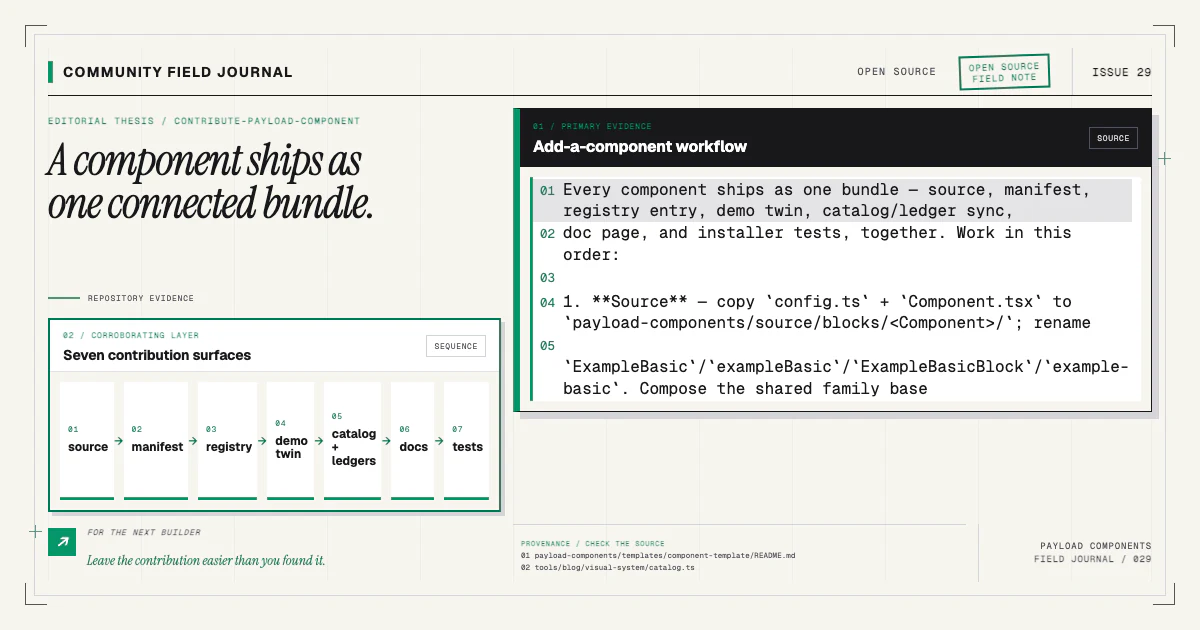
The complete component contribution guide makes provenance part of the same source, registry, docs, demo, and test review.
Carry required notices into distributed source
Payload Components copies files into consumer repositories. If a license or notice must accompany the
code, ensure the registry item or repository distribution delivers it in a durable way. A notice that
exists only on the marketing site may not travel with shadcn add.
Test the actual installed file set. Confirm headers, notice files, or attribution references survive registry generation and target paths. Keep the main repository's third-party notices updated as well.
Do not add enormous boilerplate headers when the license does not require them; use a clear central notice when appropriate. The goal is accurate compliance and discoverability, not ritual noise.
Include visual and data assets
Code is only part of a component. Icons, fonts, photographs, logos, sample portraits, and datasets have their own origins and permissions. Demo fixtures should avoid presenting invented people or organizations as real endorsements. Generated editorial cover art should contain no copied logos, watermarks, or misleading UI claims.
For real brand logos, record permission and usage context. For fonts, preserve required license files and verify web distribution rights. For screenshots, remove private data and confirm the application may be shown.
The social-proof article covers content permission and claim review at the CMS layer.
Make provenance reviewable in pull requests
A contribution adapted from upstream should include:
- canonical source and exact version;
- applicable license and notice location;
- summary of modifications;
- assets and their separate sources;
- how attribution reaches downstream installs;
- tests proving required files are distributed.
Reviewers can then evaluate lineage beside implementation. If provenance is discovered later, add it promptly and assess whether past distributions need correction. Do not erase history to make the repository look more original.
Automated checks can require known notice files or reject unapproved asset types, but human review is still needed to match terms with actual use.
Preserve provenance through refactors
Moving code, splitting a family, or rewriting a component can make original attribution look distant. Keep the provenance record linked until the repository has a deliberate reason to change it. A large refactor does not automatically remove license obligations or historical value.
When taking a newer upstream version, record the new commit and update the adaptation summary. Review the upstream license again. Compare changes rather than replacing local accessibility or Payload contracts blindly.
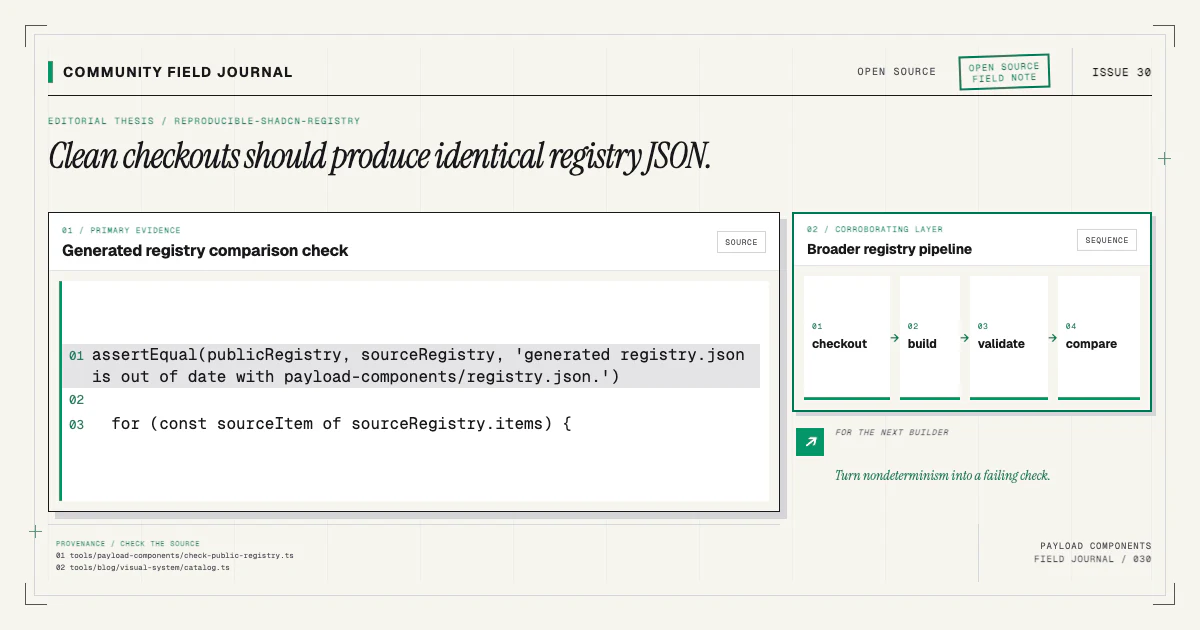
The reproducible registry guide explains how source and notices become deterministic public items.
Build trust through transparent lineage
This project is community-first and MIT. That makes transparent reuse more important, not less. Open source grows by building on prior work while keeping credit and terms intact. Good provenance also makes maintenance easier: contributors know where to report upstream bugs, compare improvements, and avoid repeating an adaptation.
Install a component and inspect every delivered file, including any shared or notice source:
npx payload-components add hero-basicIf you find missing or unclear lineage, open a focused issue through the contributing guide with the suspected upstream source and evidence. Correcting provenance is substantive maintenance. The permanent record is part of what makes copied source safe to share, change, and pass on.