The easiest component roadmap to write is a list of attractive screenshots. The useful roadmap is harder: it reflects the sections people repeatedly need, the install assumptions real repositories break, the content states editors struggle with, and the contributions maintainers can support well.
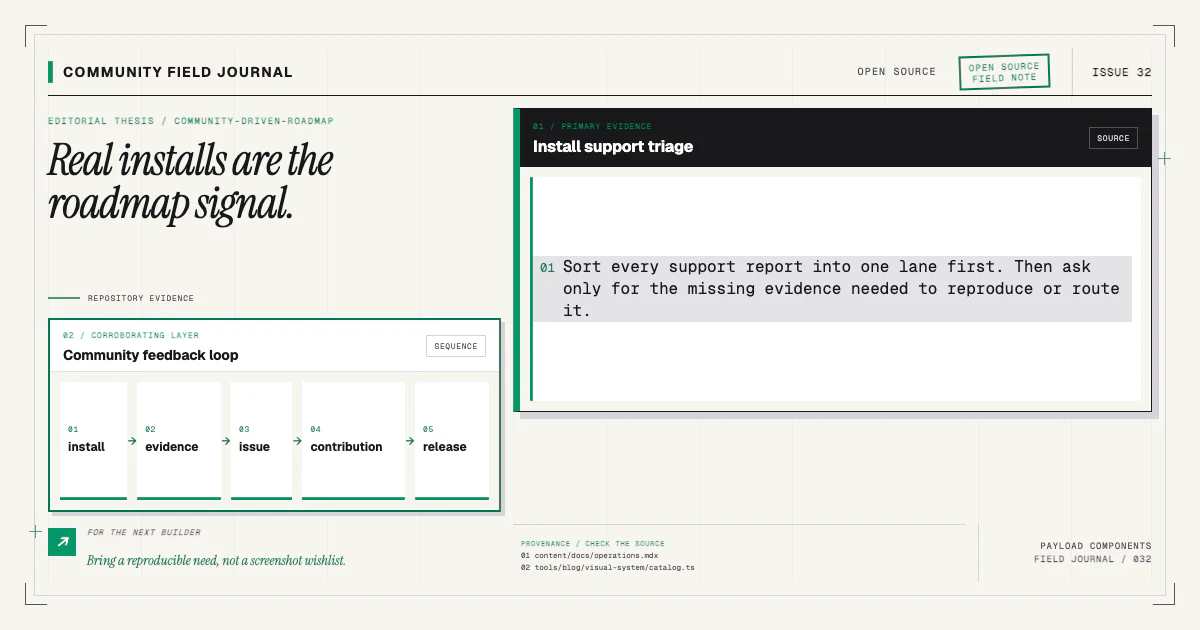
Payload Components is community-first. Adoption and contribution are the measure, not a catalog count or a funnel. That means the feedback loop begins after installation, when source meets a real starter, schema, design system, editor, and deployment.
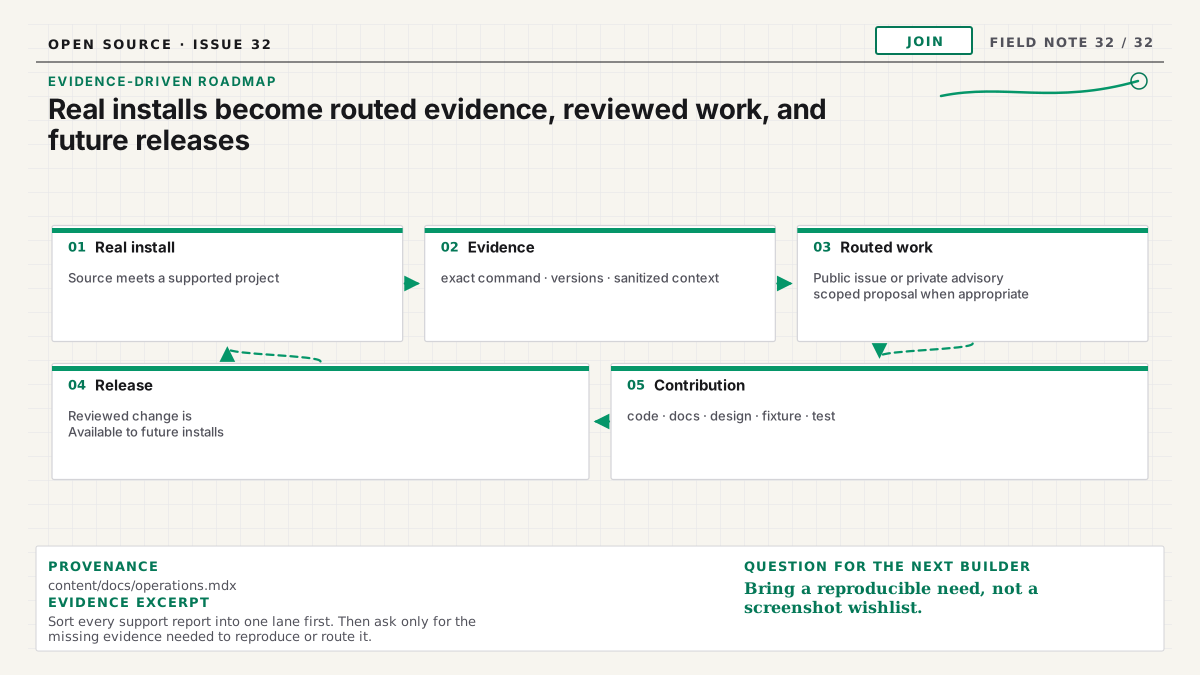
Count problems, not applause
A request such as “add more heroes” is a signal, not yet a specification. Ask which page job the current hero cannot perform, what content is required, how mobile order changes, and whether the difference is structural or cosmetic.
A bug report such as “installer broke my project” becomes useful when it includes the supported starter version, sanitized host shape, failed stage, doctor output, and expected narrow diff. That evidence can become detection logic and a fixture.
Positive feedback matters too. A component repeatedly installed without modification may indicate a stable contract. A component always rewritten in the same way may indicate a missing field, wrapper, or variant. The roadmap should learn from both outcomes.
Make installation observable
The project does not need invasive analytics to learn. Ordinary reports can become a public issue, while security-sensitive evidence belongs in a private advisory. Discussions, pull requests, reproducible fixtures, and voluntary examples provide more context. If anonymous aggregate install data is ever considered, its collection and privacy contract should be transparent and optional.
Today, .payload-components/state.json exists for local recovery, not remote tracking. Do not turn a
project state file into telemetry by implication. Trust grows when tools do exactly what their docs
say.
The doctor article shows how local diagnostics can produce a useful sanitized report without modifying or uploading the repository.
Prefer reproducible issues
A strong issue contains:
- the desired or failing outcome;
- the relevant component and version;
- Payload, Next.js, Node, and package-manager versions;
- a minimal collection or renderer shape;
- exact command and failed stage;
- expected and actual behavior;
- accessibility or responsive context when visual;
- confirmation that secrets and private data were removed.
Templates should help people provide this evidence without making issue creation hostile. Maintainers can ask focused follow-ups and convert common reproductions into fixtures.
The contributing guide is the shared path for proposing and validating changes.
Rank by community value and maintenance cost
Frequency is useful but not sufficient. A rare data-loss or unsafe-link issue outranks a common cosmetic request. An accessibility failure can block a section entirely for some users. An installer break affecting a supported starter can undermine every component.
I consider:
- severity and safety;
- number and diversity of real projects affected;
- fit with the registry's Payload v3 + Next.js boundary;
- clarity of the content and structural contract;
- long-term test and maintenance burden;
- presence of a contributor or reproducible fixture.
A roadmap item should be small enough to finish completely. “Support every Payload architecture” is not actionable. “Support this documented RenderBlocks shape with detection, anchored patches, idempotency tests, and docs” is.
Let families grow from recurring structure
New variants should represent repeated hierarchy or interaction needs. Cosmetic changes belong in the consumer's source and tokens. Optional content belongs in fields. A new family member earns its name when the schema, React structure, preview, and tests tell a distinct story.
The variant design article gives the decision model. It protects the roadmap from becoming an exhaustive list of prop combinations.
Sometimes the right roadmap outcome is improved documentation or a shared field module, not another card. A recurring installation question may reveal that the contract is hidden rather than absent.
Require complete contributions
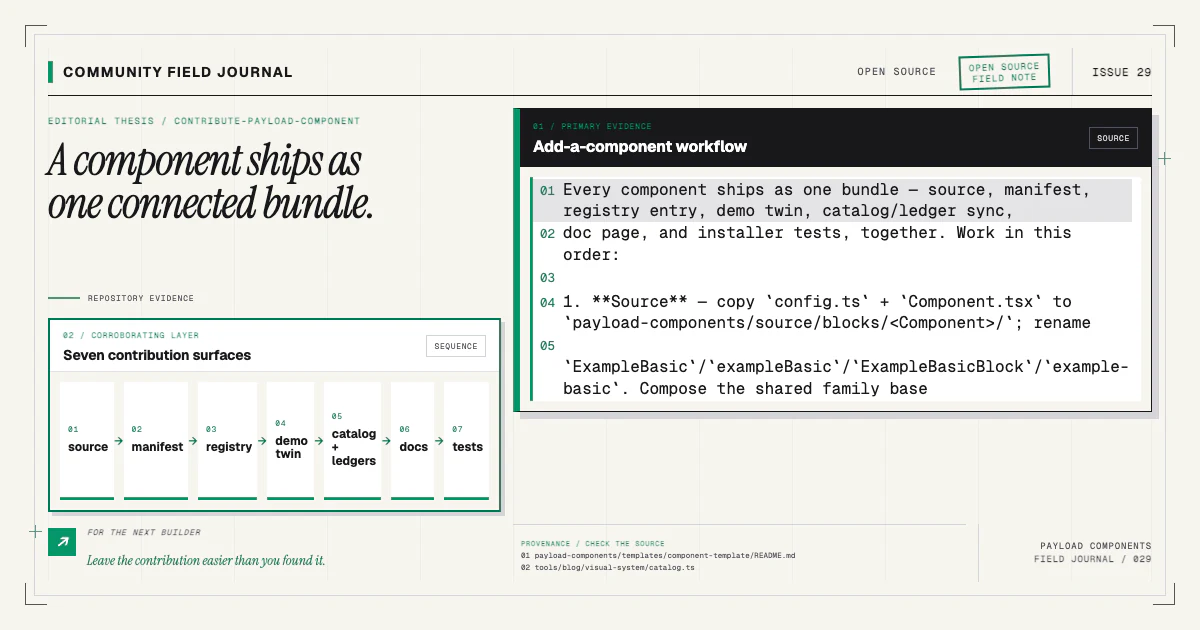
A component proposal becomes shippable when source, manifest, registry entry, docs, demo twin, installer tests, and visual baseline land together. A CLI improvement includes failure recovery and diagnostic language. An accessibility fix includes a behavior test.
This standard is not bureaucracy around contribution. It prevents the community from inheriting a beautiful partial feature whose missing surfaces become someone else's emergency. The end-to-end component guide walks through the complete unit.
Review should be kind and specific. Maintainers can help shape a proposal before a contributor builds all surfaces, but merged work should satisfy the same public contract as existing components.
Close the loop after release
A merged change is a hypothesis. Announce what changed, link the issue and docs, and invite the original reporter to try the release. If the fix works only in the fixture, reopen the investigation with the new evidence.
Update support matrices and docs when behavior changes. Keep changelog or release notes focused on what users need to verify. Preserve provenance for adapted work. Watch for related reports that suggest the abstraction is still too narrow.
Publishing makes the change available to future installs; it does not reach every existing project automatically. The next install is part of the loop. A release becomes trusted through repeated real use, not through the confidence of its merge message.
Keep public priorities legible
Use issues and project labels to distinguish confirmed bugs, component proposals, starter support, documentation, accessibility, and help wanted work. Explain why something is not planned when it falls outside the architecture boundary. Avoid promising dates the volunteer project cannot support.
A community roadmap should leave room for contributors to champion a well-scoped need. Maintainers still protect coherence: a complete proposal can be declined if it duplicates a variant, introduces unsafe behavior, or moves the docs site toward a Payload runtime.
Legible boundaries make contribution easier because people know where effort will compound.
Begin with one honest install
Choose a component your project needs, install it on a branch, read the diff, and publish it with real content:
npx payload-components add hero-basicBrowse the catalog and architecture docs before proposing a new surface. If the install succeeds, share the composition and awkward content states you tested. If it fails, run doctor and bring a sanitized reproduction. If you improve the source, contribute the docs and test that make your insight reusable.
That is the roadmap loop I want: not a queue handed down to users, but a public record of real Payload projects teaching a shared registry what to become next.