A block config can be valid and still be unpleasant to maintain. Payload only needs enough information to construct the field, but a production repository needs more: stable persisted identity, useful generated names, editor-facing language, validation, and a content model that does not encode one fragile screenshot.
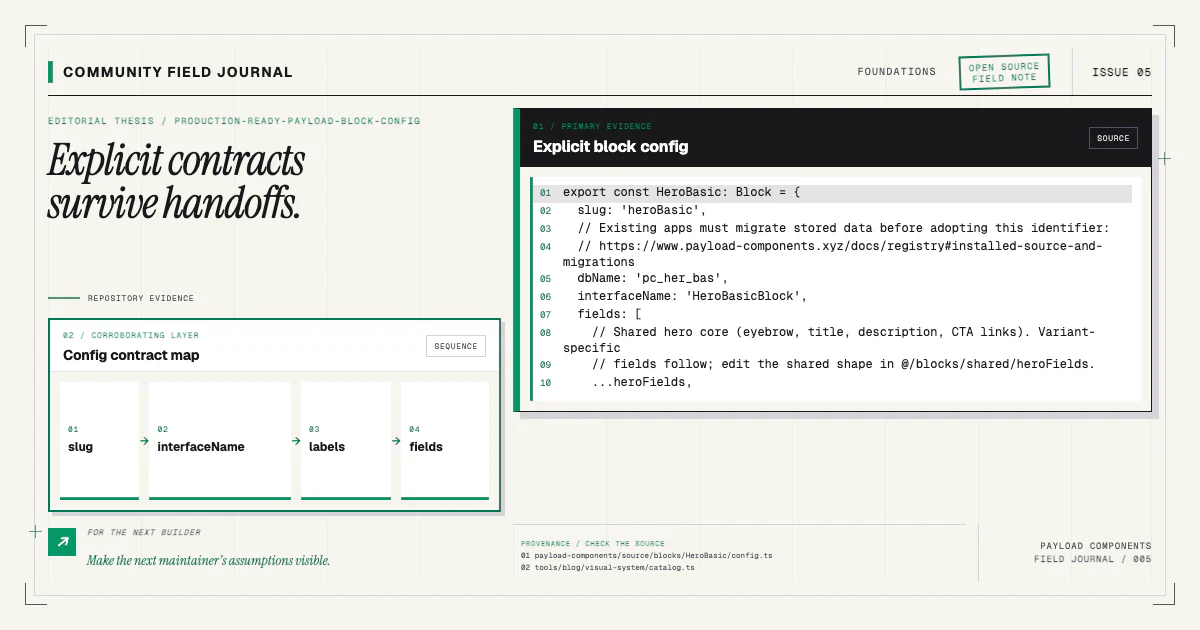
I use four explicit properties as the starting contract: slug, interfaceName, labels, and
fields. The Payload Blocks reference is the authority
for the API. This article explains the design pressure behind each choice and how I review a config
before it enters the component catalog.
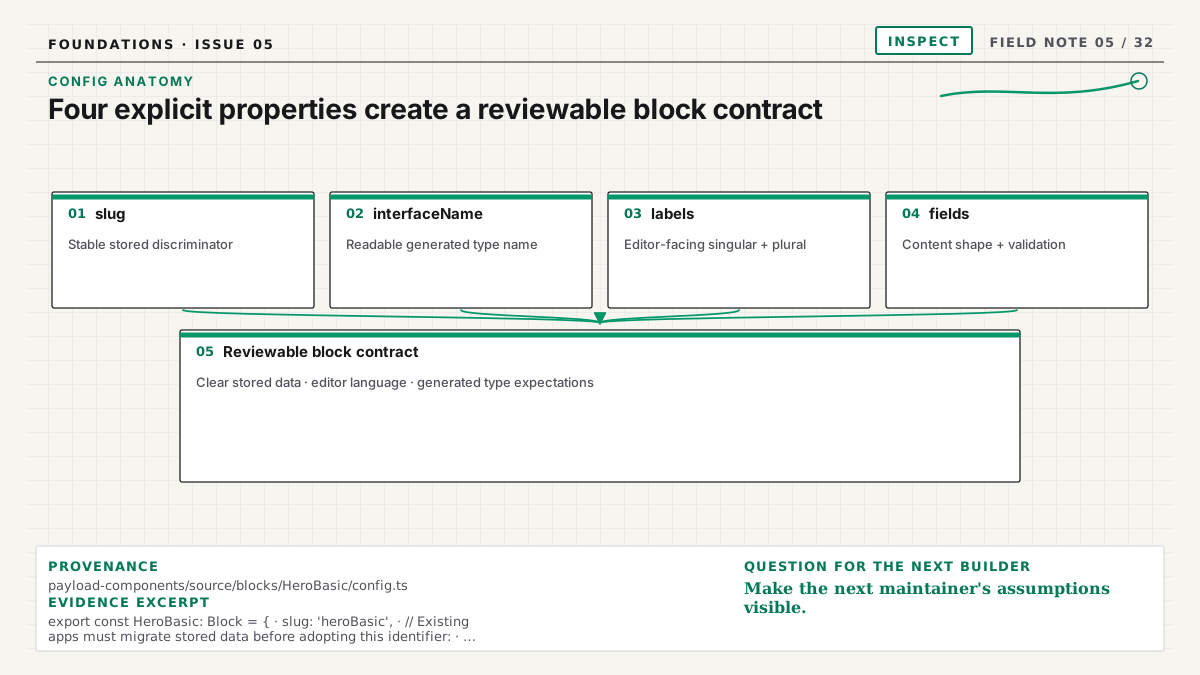
Give persisted data a stable discriminator
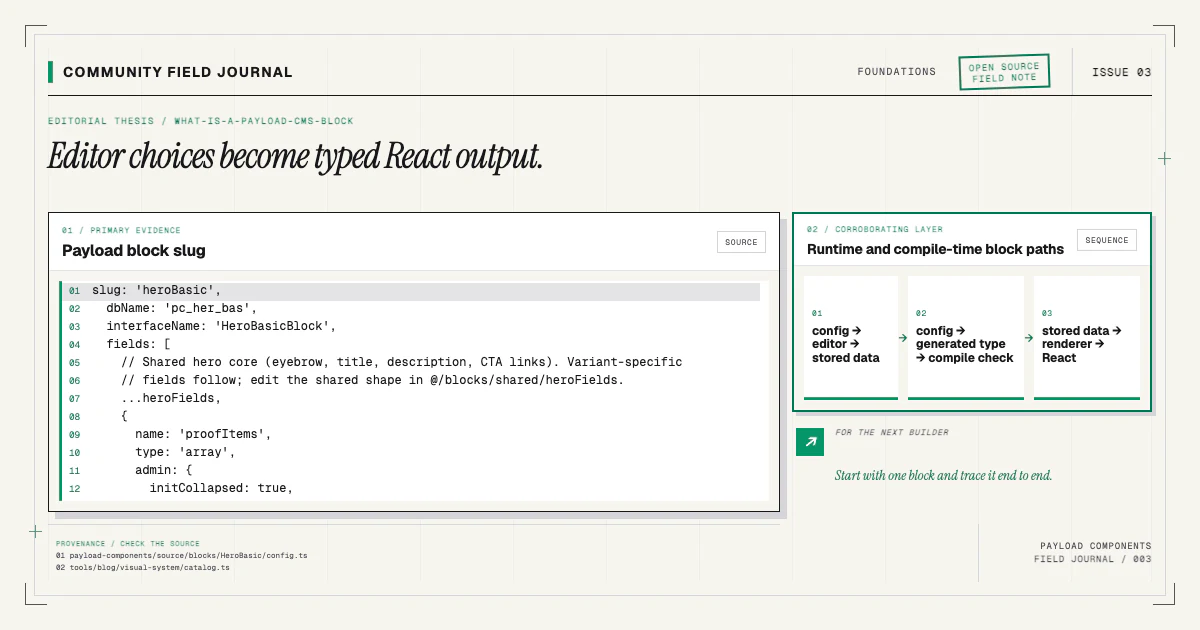
The slug becomes the block's stored blockType. Treat it as data, not display copy. Choose a clear,
specific identifier such as heroBasic or featureBento, then assume documents will carry it for a
long time.
Renaming a slug is a data migration. Changing heroBasic to hero in source does not rewrite old
documents; those documents still ask the renderer for the original discriminator. If a rename is
necessary, plan the migration, update renderer compatibility deliberately, regenerate types, and
test both existing and new content.
This is one reason every structural variant has a suffix. A bare hero looks convenient until a
second structure appears. heroBasic and heroVideo state their identities early and keep catalog,
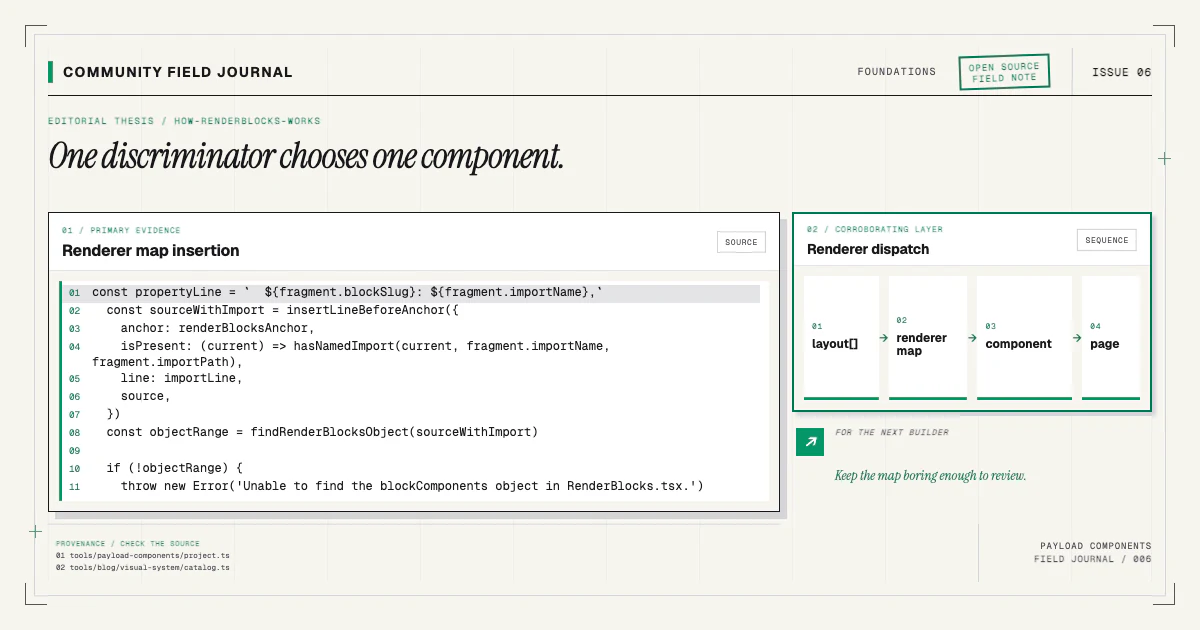
manifest, generated union, and renderer keys unambiguous.
Name the generated interface for humans
Payload can generate TypeScript from the config. Without an explicit interfaceName, generated
names may be less predictable across a large schema. I prefer a readable PascalCase name such as
HeroBasicBlock:
export const HeroBasic: Block = {
  slug: 'heroBasic',
  interfaceName: 'HeroBasicBlock',
  // ...
}
The interface appears in frontend props, tests, migrations, and editor tooling. It should identify
the content shape without colliding with the React component name. A consistent *Block suffix
makes code search useful and distinguishes generated data from implementation.
Do not hand-maintain a duplicate interface beside the config. Payload's generated TypeScript interfaces make the schema authoritative. A handwritten twin will eventually diverge, and a cast will hide the moment it does.
Write labels for the chooser
Labels are the words editors see when they select and manage blocks. Code-oriented slugs are poor UI copy, especially once the catalog has several related variants. Provide both singular and plural labels:
labels: {
  singular: 'Basic hero',
  plural: 'Basic heroes',
}
Keep the label descriptive rather than promotional. An editor needs to distinguish structure and purpose quickly. “Split feature section” is more useful than “Stunning showcase.” If variants are visually similar, use the same vocabulary as the docs and preview titles so a person can move from catalog to admin without translating names.
Labels also deserve localization when the admin team works in multiple languages. That is a product requirement around the Payload config, not something the frontend renderer can repair.
Model content, not CSS controls
Fields are the largest part of the config and the easiest place to lose the boundary. I ask one question for every field: is this value meaningful content, or am I asking an editor to compensate for an inflexible component?
Good fields describe meaning: eyebrow, heading, description, links, image, testimonial quote, author, feature items. Weak fields expose implementation: arbitrary padding numbers, hex colors, pixel font sizes, grid-template strings. The latter turn the admin into a low-quality visual editor and make every saved document dependent on today's CSS.
Use structural variants for materially different layouts. Use optional fields for content-level variation. A hero with or without an eyebrow is the same structure. A hero whose primary medium is full-bleed video is likely a different registry item. The guide on variants without prop explosion develops this decision further.
Make validation express real requirements
Mark a field required when the component cannot communicate without it. A hero heading is often
required. An eyebrow usually is not. Avoid making every field required just to keep demo cards full;
editors will respond with filler, and the frontend will still be untested for real omissions.
Use field validation for content invariants that Payload can enforce: sensible array minimums and maximums, allowed relationship targets, URL format policies, and conditional requirements. Then make the React component resilient to values that can still be absent because of migrations, drafts, access control, or older documents.
For arrays, model the item as a small coherent object. A feature item might contain an icon key, title, description, and optional link. Give the array useful labels, constrain it only when the design has a genuine capacity, and test the minimum and maximum in the preview.
Share field definitions as shipped source
Related variants often share a content vocabulary. Instead of copying the same heading and link fields into three configs, put them in a real source module and spread them into each variant:
export const HeroVideo: Block = {
  slug: 'heroVideo',
  interfaceName: 'HeroVideoBlock',
  labels: { singular: 'Video hero', plural: 'Video heroes' },
  fields: [
    ...heroFields,
    { name: 'video', type: 'upload', relationTo: 'media', required: true },
  ],
}
That shared module must ship with every variant that imports it. In this registry, it belongs under
payload-components/source/blocks/shared, in each registry item's files, and in each manifest's
owned files. Internal source modules are not shadcn registryDependencies; that mechanism resolves
public registry components, not private relative imports. The dedicated
shared-fields guide shows the complete pattern.
Keep admin-only choices out of the renderer
Some field options exist to improve authoring: descriptions, admin conditions, row layout, groups, and custom components. Use them to clarify a complicated model, but do not let critical business rules exist only as visual hints. A hidden field can still be present in historical or API-written data. Server-side validation and access control remain the enforcement boundary.
When a block references custom admin UI, component paths participate in Payload's import map. Follow the official custom components guidance, regenerate the map after path changes, and verify the admin build. A frontend typecheck cannot prove that an admin module resolves.
Review the whole contract
Before I call a config ready, I check the following:
- The slug is specific, stable, and matches the renderer key.
- The interface name is explicit and readable.
- Singular and plural labels help an editor choose correctly.
- Fields describe content rather than arbitrary styling.
- Required flags and validation match genuine component invariants.
- Optional values have deliberate empty states in React.
- Shared fields live in a source file every consuming variant ships.
- Types and the admin import map regenerate successfully.
- Docs explain the content model in the same language as the admin.
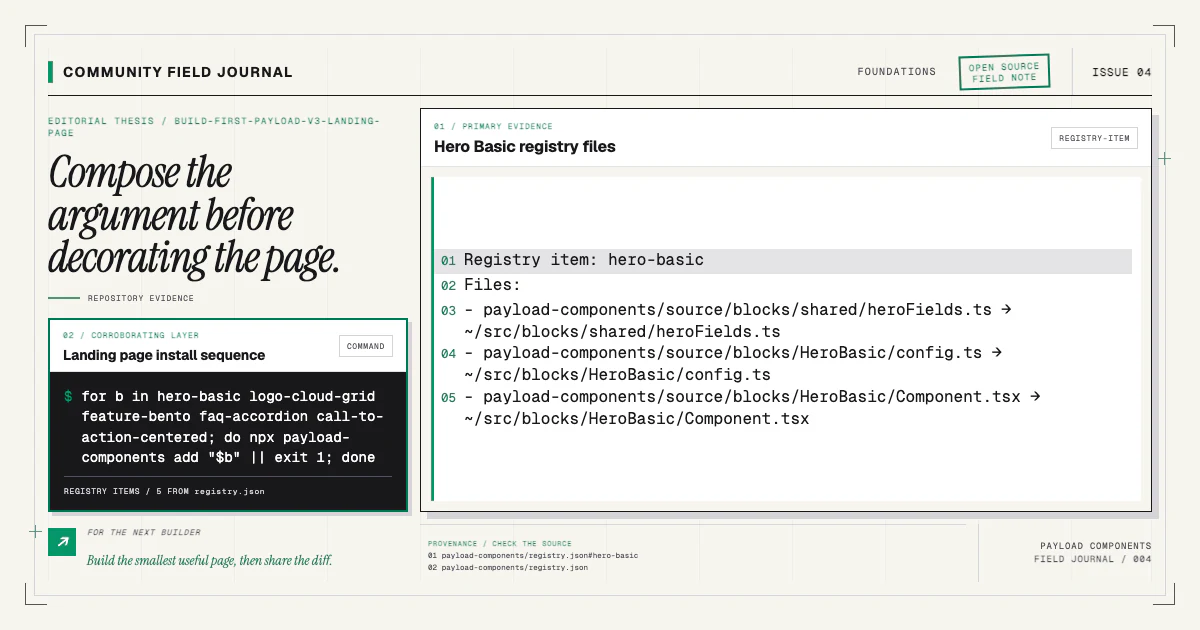
You can inspect these decisions in the Hero Basic documentation, then install the source on a branch and review it in context:
npx payload-components add hero-basicIf you find a config that makes an editor fight the design, bring the concrete content case to the repository. A good contribution can be a field rename, a validation improvement, a clearer label, or a fixture that proves an empty state. The community value is not the number of configs; it is how reliably each config communicates its contract.