RenderBlocks is the small function at the center of a block-based frontend. Payload has already
validated and stored the content. React components already know how to draw individual sections.
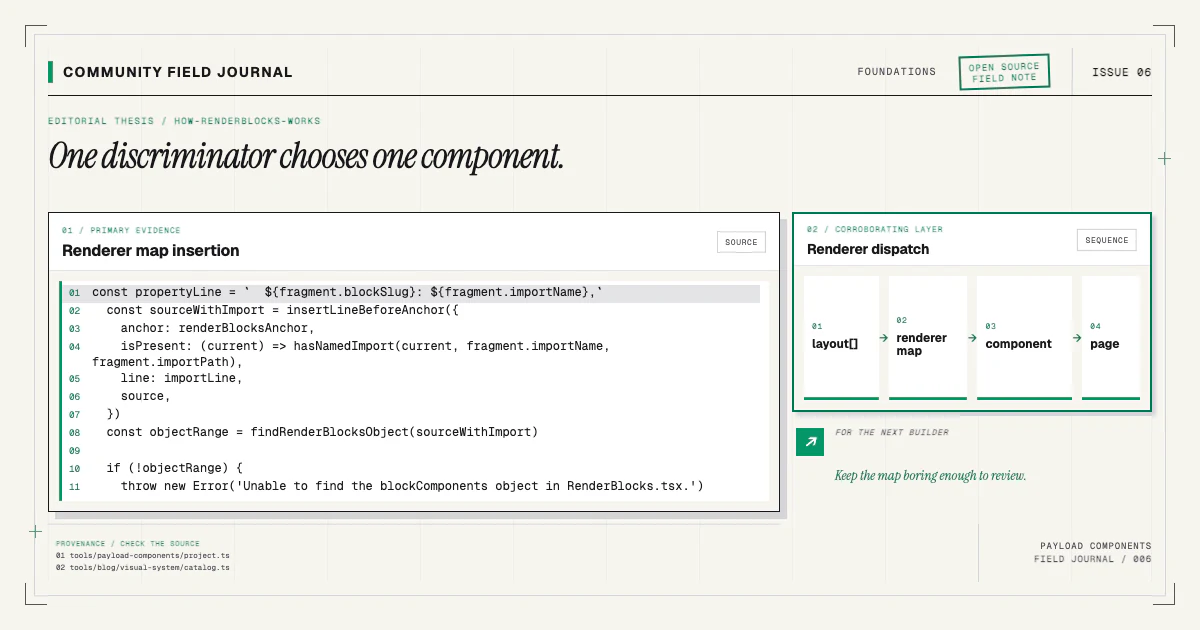
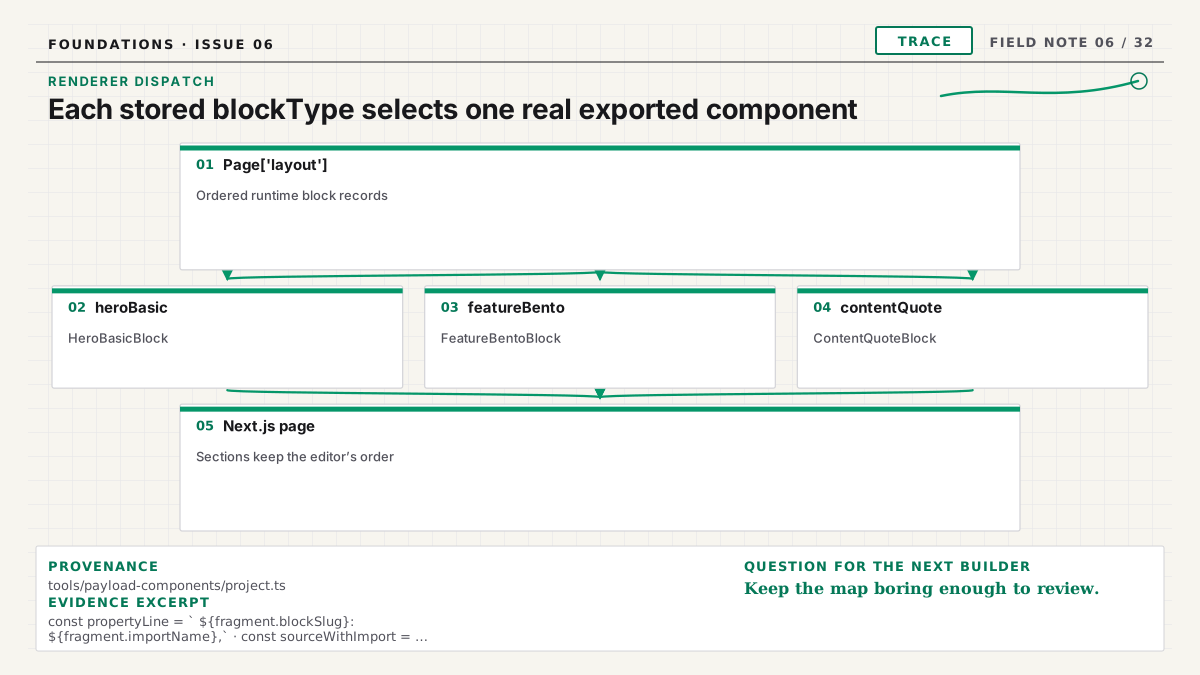
The renderer joins those systems by translating each saved blockType into the corresponding
component without losing order or type information.
Because the function is short, teams sometimes treat it as incidental plumbing. I treat it as an architectural boundary. A clear renderer makes missing registration obvious, keeps wrapper behavior consistent, and gives TypeScript one place to prove that stored data and component props agree.
Begin with the generated layout type
A Pages collection with a Blocks field produces an array whose entries form a discriminated union.
Payload's type generation documentation
explains how payload-types.ts is derived from the config. In simplified form, the result resembles:
type LayoutBlock =
  | { blockType: 'heroBasic'; id?: string; heading: string; copy?: string }
  | { blockType: 'featureBento'; id?: string; items: FeatureItem[] }
  | { blockType: 'contentQuote'; id?: string; quote: string; attribution?: string }
The blockType is the discriminator. When code checks that value, TypeScript can narrow all the
other fields. That makes the generated union the right input to the renderer. Avoid replacing it
with a hand-written base shape or any; doing so discards the strongest connection between Payload
schema and frontend implementation.
The introduction to Payload blocks explains how the union begins in the block config and stored document. The Payload blocks implementation guide shows this renderer boundary inside the complete path from config to a live page.
Keep the component map boring
An explicit object is easy to search, patch, and review:
const blockComponents = {
  heroBasic: HeroBasicBlock,
  featureBento: FeatureBentoBlock,
  contentQuote: ContentQuoteBlock,
}
The keys must match persisted slugs exactly. A clever naming transform—converting kebab case, loading files by convention, or deriving exports dynamically—can save a few lines while making the failure mode much less visible. For a component registry, explicit imports and keys create a clean diff and a stable text anchor for installation.
The map is also a useful inventory. If Payload lets editors save pricingCards but the object has no
matching key, the omission is apparent in one place. That transparency is more valuable than
eliminating repetitive imports.
Type the map at the boundary
React components for different blocks accept different props, so perfectly typing a heterogeneous
map requires care. One practical approach is to preserve the generated union, narrow on
blockType, and keep the unavoidable association localized rather than casting every component.
Another is to define a mapped type from discriminators to extracted union members:
type BlockByType<T extends LayoutBlock['blockType']> = Extract<
  LayoutBlock,
  { blockType: T }
>

type RendererMap = {
  [Type in LayoutBlock['blockType']]: React.ComponentType<BlockByType<Type>>
}
In a closed application where every union member must render, this can make missing keys a compile
error. In a registry or staged migration, you may intentionally render a subset, so
Partial<RendererMap> and a visible fallback are more honest. The right strictness depends on who
owns the schema and renderer together.
The important rule is that any assertion lives inside this boundary and is backed by a map whose keys and values are reviewed together. Do not push uncertainty into every block component.
Preserve the editor's order and React identity
The renderer maps the array in its saved order. Never sort by block type or component name. The sequence is editorial data.
Use a stable stored id as the React key when Payload provides one. An index is a reasonable last
resort for immutable server output, but it can produce misleading identity if client-side editing,
preview updates, or animation reorders blocks. Do not generate a random key during render; that
forces React to remount every section on every pass.
return blocks.map((block, index) => {
  const Component = blockComponents[block.blockType]
  if (!Component) return null

  return <Component key={block.id ?? `${block.blockType}-${index}`} {...block} />
})
Make unknown blocks observable
Returning null is safe for the user but quiet for the developer. An unknown discriminator can
mean a missing renderer registration, an old document after a rename, a draft created against a
newer schema, or stale generated code. In development, log enough context to act:
if (!Component) {
  if (process.env.NODE_ENV !== 'production') {
    console.warn(`No renderer registered for ${block.blockType}`)
  }
  return null
}
On a production editorial site, you may also send the condition to observability without exposing internal details to readers. A visible generic placeholder is useful in preview, where editors need to know content is missing; it is usually inappropriate on a public route. Keep preview and public failure behavior deliberate.
If a block is absent today, the not-rendering checklist walks through stored data, collection registration, mapping, types, and cache in diagnostic order.
Standardize wrapper props
Block components often accept id, className, and a container option. Those props support section
anchors, page-level spacing, and occasional full-bleed media. Preserve them instead of hiding each
component inside a renderer-specific wrapper that changes semantics.
A useful division is:
- The renderer controls iteration, lookup, keys, and common page context.
- The block controls its semantic section, internal container, and visual treatment.
- The page controls the layout array and any preview or localization context.
If the renderer injects spacing, every block becomes dependent on that one caller. If every block invents external margins, adjacent combinations become hard to tune. In this project, shared tokens and wrapper conventions keep those responsibilities predictable while leaving installed source editable.
Respect server and client boundaries
Most RenderBlocks functions can be server components. Payload data arrives on the server, the map
is static, and many sections need no client JavaScript. A block that contains an accordion, carousel,
or form can put the client boundary around the interactive part rather than forcing the entire
renderer to use use client.
This matters for composition. A server renderer can include a mix of server and client descendants, but importing server-only modules into a client renderer will fail. Keep data fetching above the map, pass serializable props into client islands, and avoid turning the dispatcher into a global state container.
Verify the contract end to end
I test renderer behavior at three levels. TypeScript catches prop drift. An integration test asserts that every installed block registers a matching map key and that reruns do not duplicate it. Browser tests publish or fixture representative layout data and confirm sections appear in order without overflow.
For a new component, render minimum, typical, and stress content: omitted optional fields, long text, maximum arrays, and awkward media ratios. The happy-path catalog example proves very little about the dispatch layer if every value is perfect.
You can inspect the project's architecture documentation and the live catalog previews, then install a small block to see the exact renderer patch:
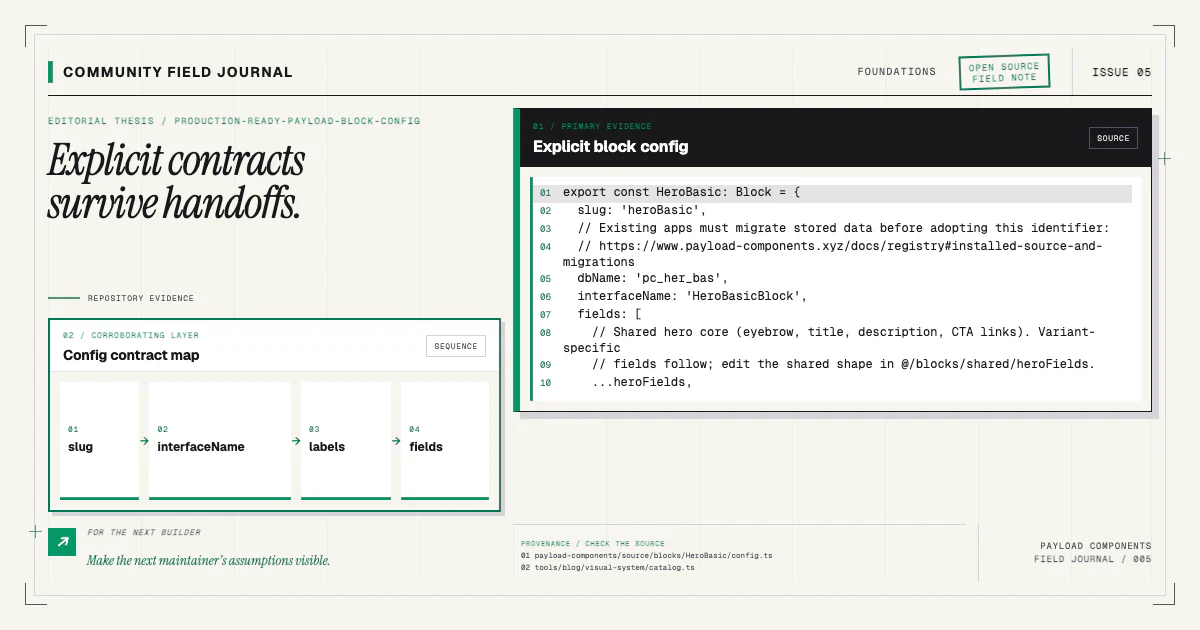
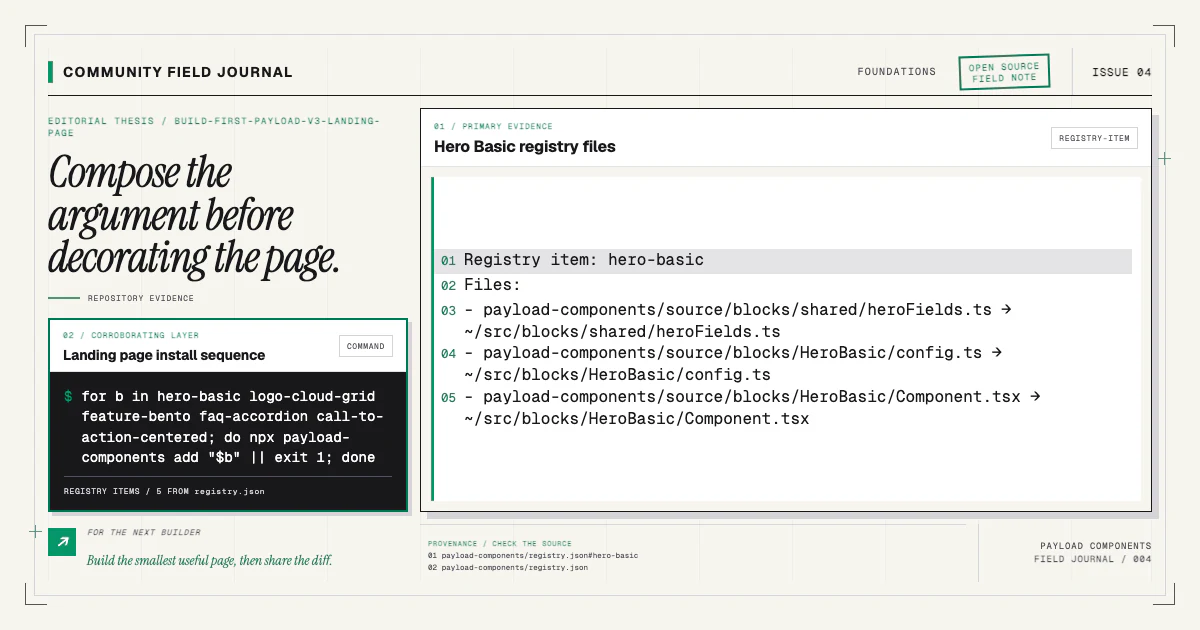
npx payload-components add hero-basicRead the map entry and its import as one unit. If your application uses a different renderer shape, share a minimal fixture or propose a documented adapter. Supporting real, legible patterns is more useful to the community than making the installer guess across arbitrary source code.