Payload already knows the shape of every block. When generated types reach the Next.js renderer
intact, blockType can narrow each layout item to the fields its React component expects. The main
engineering task is preserving that knowledge across a heterogeneous component map without filling
the codebase with any and assertions.
There is no single perfect pattern for every application. A closed renderer that owns every schema member can be exhaustive. A registry-aware renderer may intentionally support a subset during migration. Both can keep uncertainty localized and observable.
The target is not a clever generic with zero visible repetition. The target is a change where adding one block produces useful compiler feedback in the config, component props, renderer inventory, and fixtures. If a type abstraction makes an error shorter but the mapping harder to review, it has moved complexity rather than removed it. Prefer the smallest pattern your team can explain while looking at the generated union and one component addition.
That restraint matters for distributed source. Consumers will customize the renderer after install, often without the original author's context. Ordinary TypeScript utilities and explicit keys are a more durable public interface than a local type puzzle.
Generate instead of duplicating
Run Payload's configured type generator after schema changes. The official type generation documentation describes the source and output configuration. Import the resulting Page and block interfaces into frontend code.
Do not write a second HeroBlock interface that resembles the config. It will diverge. Do not use a
cast to make yesterday's generated file accept today's schema. Regenerate and inspect the diff.
A Page layout often has a form like:
type Layout = NonNullable<Page['layout']>
type LayoutBlock = Layout[number]
type BlockType = LayoutBlock['blockType']
These aliases remain tied to the generated collection. If the schema adds a block, the union changes and the compiler can show which frontend contracts need attention.
Type each component with its generated member
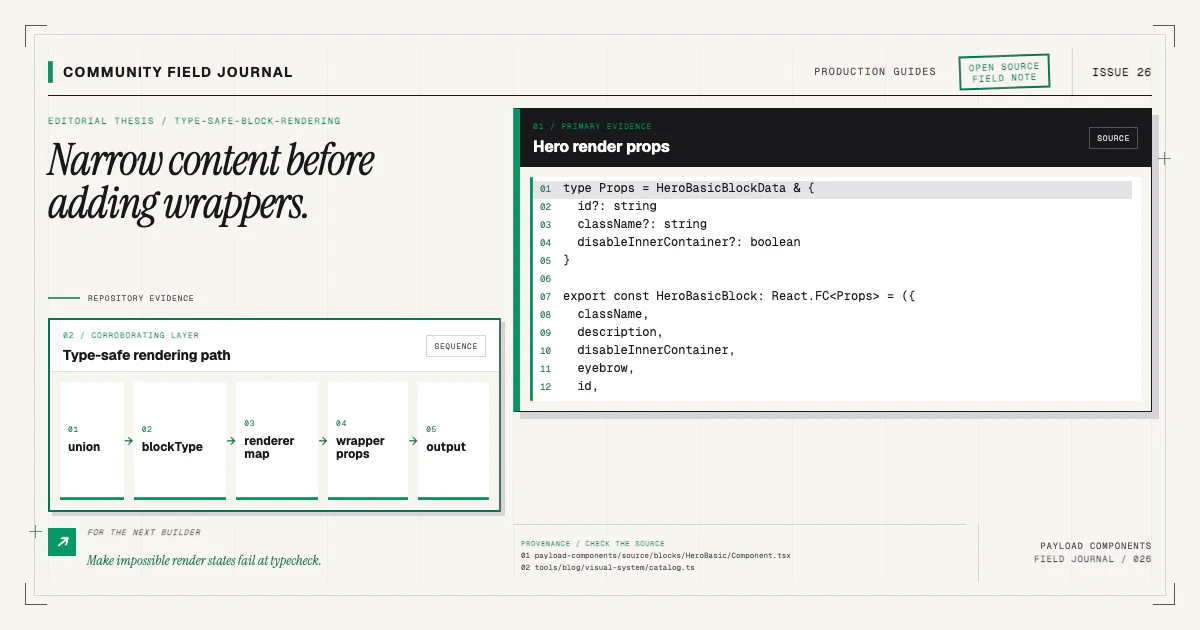
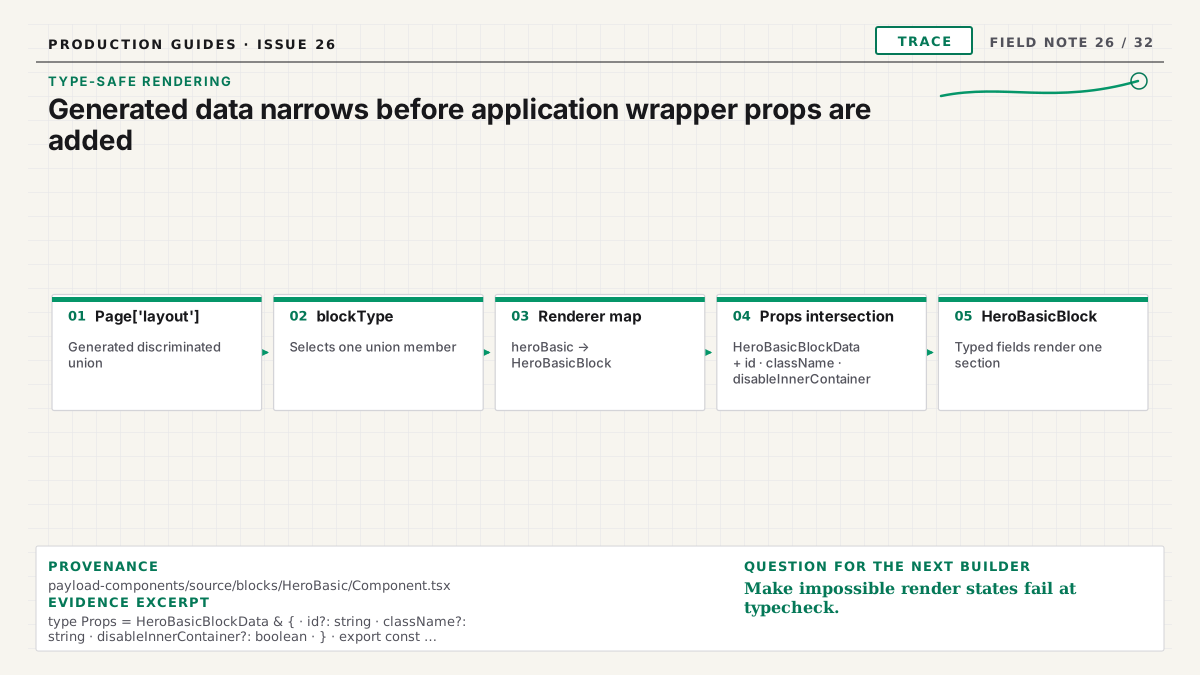
The simplest component receives its generated block interface plus optional layout wrappers:
import type { HeroBasicBlock as HeroBasicBlockData } from '@/payload-types'

type HeroBasicProps = HeroBasicBlockData & {
  className?: string
  disableInnerContainer?: boolean
  id?: string
}

export function HeroBasicBlock(props: HeroBasicProps) {
  // ...
}
Do not omit wrapper props that the renderer or page composition relies on. Preserve them consistently across installed blocks. Keep runtime-only context separate when it is not stored content—for example, preview state, locale, or a link renderer can be an additional prop rather than a fake Payload field.
When a component transforms data for a child, keep the transformation typed. Avoid spreading a broad
block object into a DOM element, which can leak blockType, IDs, and nested objects as invalid
attributes.
Extract union members by discriminator
TypeScript's Extract utility connects a map key to its exact union member:
type BlockOf<Type extends BlockType> = Extract<
  LayoutBlock,
  { blockType: Type }
>

type BlockRendererMap = {
  [Type in BlockType]: React.ComponentType<BlockOf<Type>>
}
A complete application can define the map with satisfies BlockRendererMap. Missing or misspelled
keys become compile errors, and each component must accept the corresponding member.
const blockComponents = {
  heroBasic: HeroBasicBlock,
  featureBento: FeatureBentoBlock,
  contentQuote: ContentQuoteBlock,
} satisfies BlockRendererMap
This pattern works best when generated block discriminators are literal types and the renderer owns all members. If the union includes blocks rendered elsewhere, derive the subset or use a partial map with an explicit fallback.
Localize the heterogeneous lookup problem
Even with a typed map, indexing it with a union value and then spreading a union object can exceed what TypeScript proves about the correlation. The compiler sees a union of components and a union of props, and the relationship can be lost at the dynamic lookup.
Do not respond by making the whole map Record<string, React.ComponentType<any>>. Use a small helper,
a switch that narrows each case, or one justified assertion inside the renderer boundary. The
component files and callers should remain strictly typed.
A switch is verbose but fully transparent:
switch (block.blockType) {
  case 'heroBasic':
    return <HeroBasicBlock key={block.id} {...block} />
  case 'featureBento':
    return <FeatureBentoBlock key={block.id} {...block} />
  default:
    return assertNever(block)
}
An object map produces cleaner installer patches and inventory. Choose the trade-off deliberately and test the boundary. The RenderBlocks article covers runtime dispatch.
Use exhaustive checks when the schema is closed
An assertNever helper makes an unhandled union member visible during compilation:
function assertNever(value: never): never {
  throw new Error(`Unhandled block: ${JSON.stringify(value)}`)
}
Use this only where every member must render. Throwing on a public page may be too harsh for stale documents or staged deployments. The build-time exhaustive check and runtime fallback can be separate: enforce map completeness in source while logging and omitting an unknown persisted value in production.
During schema rollouts, deploy ordering matters. A document created with a new block can reach an old frontend instance. Backward-compatible mapping or coordinated deployment may be necessary even when the latest code is exhaustive.
Narrow relationships at runtime
Payload relationships and uploads may be returned as an ID or populated document depending on depth, access, and query selection. Generated types correctly expose the union. Do not assert that a media field is populated because the happy-path query usually sets depth.
function isMedia(value: string | Media | null | undefined): value is Media {
  return typeof value === 'object' && value !== null
}
Prefer a project type guard that checks stable fields, and handle the ID or missing case. If the component requires media, the server query can populate it, but access filtering and older data still deserve a safe state.
When inspecting Payload field configurations in tooling, use Payload's exported field type guards instead of unsafe structural casts. Config field unions and document relationship unions are different domains; keep their guards separate.
Keep rich text and links typed at their serializers
Rich-text data should enter one controlled renderer whose node types and custom blocks are known. Avoid casting it to a string or accepting arbitrary HTML. Custom block nodes can reuse the same discriminator principles with a dedicated map.
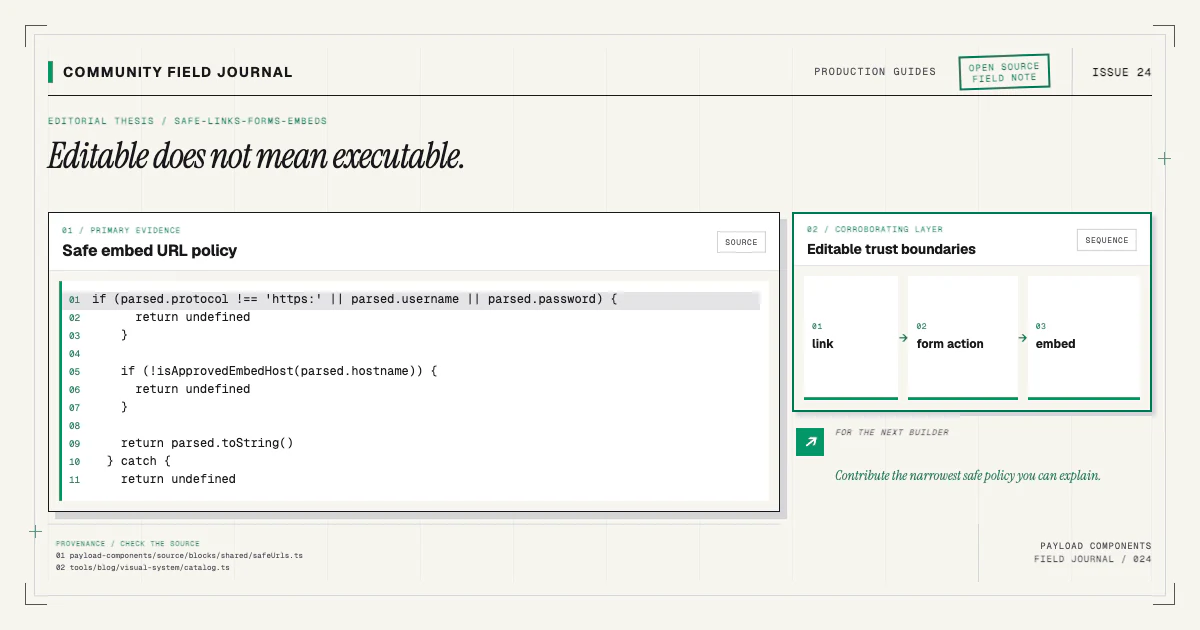
Links should use a typed internal-reference or custom-URL union. Narrow the selected branch, validate URLs, and render through one link component. The safe input guide explains the runtime trust boundary that TypeScript alone cannot enforce.
Types prove what application code expects; they do not prove stored or user-supplied data is safe. Payload validation, access control, server validation, and rendering policy remain necessary.
Preserve server component advantages
Keep the main renderer a server component when it only maps data to sections. Individual interactive
blocks can contain small client islands. A map file marked use client pulls its imports into the
client graph and prevents server-only components from participating.
Pass serializable values across the boundary. Functions, database clients, and request objects stay on the server. A form can receive an action identifier or server action according to the application's architecture without turning every content block into client state.
This pattern reduces JavaScript and keeps data fetching, access, and caching near the server route.
Test the type contract and runtime behavior
Typecheck after every config change. Add integration assertions that registry manifests, collection registration, generated discriminators, and renderer keys agree. Test installation twice so an automated map patch remains singular.
At runtime, fixture every union member and assert it renders in order. Include an unknown discriminator case through a deliberately untyped boundary to verify logging or fallback behavior. Test relationship IDs and populated values, missing optional fields, long arrays, and wrapper props.
Browser tests should cover semantics, focus, overflow, and reduced motion. Visual baselines protect representative presentation, not type safety.
Start with one inspectable mapping
Install a small component and follow its type through the config, generated file, map, and React props:
npx payload-components add hero-basicUse the Hero Basic docs to compare the content model and installed files, and read the architecture guide for the source/runtime boundary. If your renderer needs a common typed shape the current fragments do not support, contribute a minimal fixture and compile-time test. A type-safe pattern earns its place when it makes real component adds clearer without hiding runtime uncertainty behind a more elaborate generic.