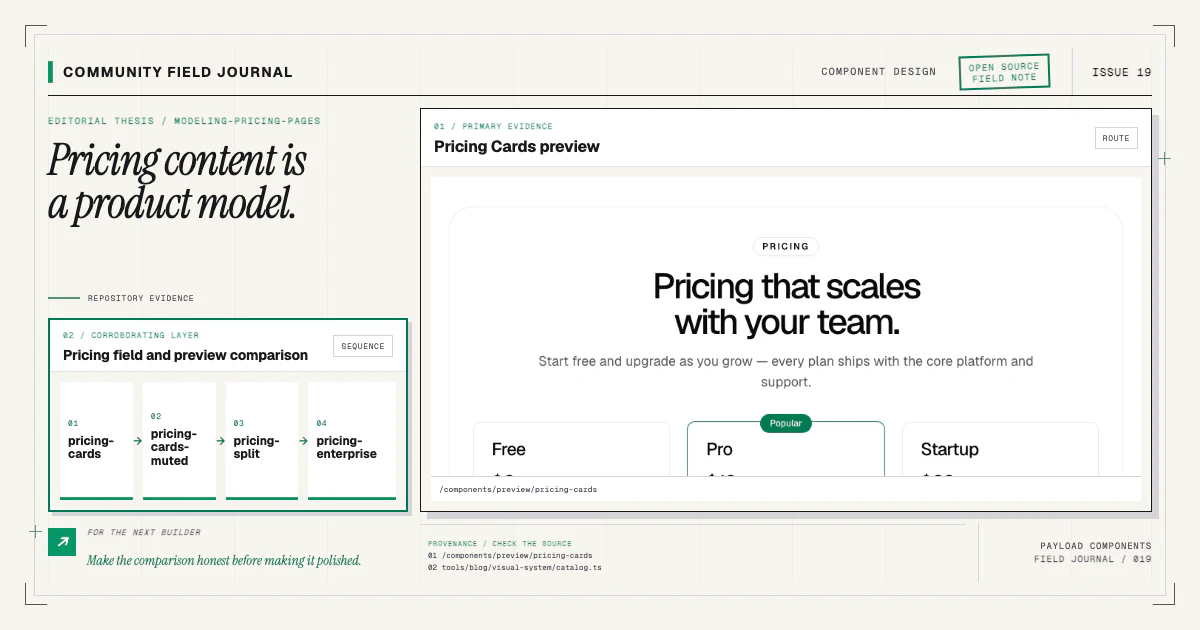
Pricing pages look like grids, but their content is closer to a small product model. A plan has a name, price presentation, billing context, description, features, action, and sometimes a badge or comparison role. If those values are hard-coded in JSX, every copy change becomes a deployment. If every CSS decision becomes a CMS field, editors inherit a fragile layout tool.
The useful middle is a content model that describes plans and evidence while structural variants own the presentation. Payload manages the values. React owns card geometry, responsive behavior, semantics, and safe link rendering.
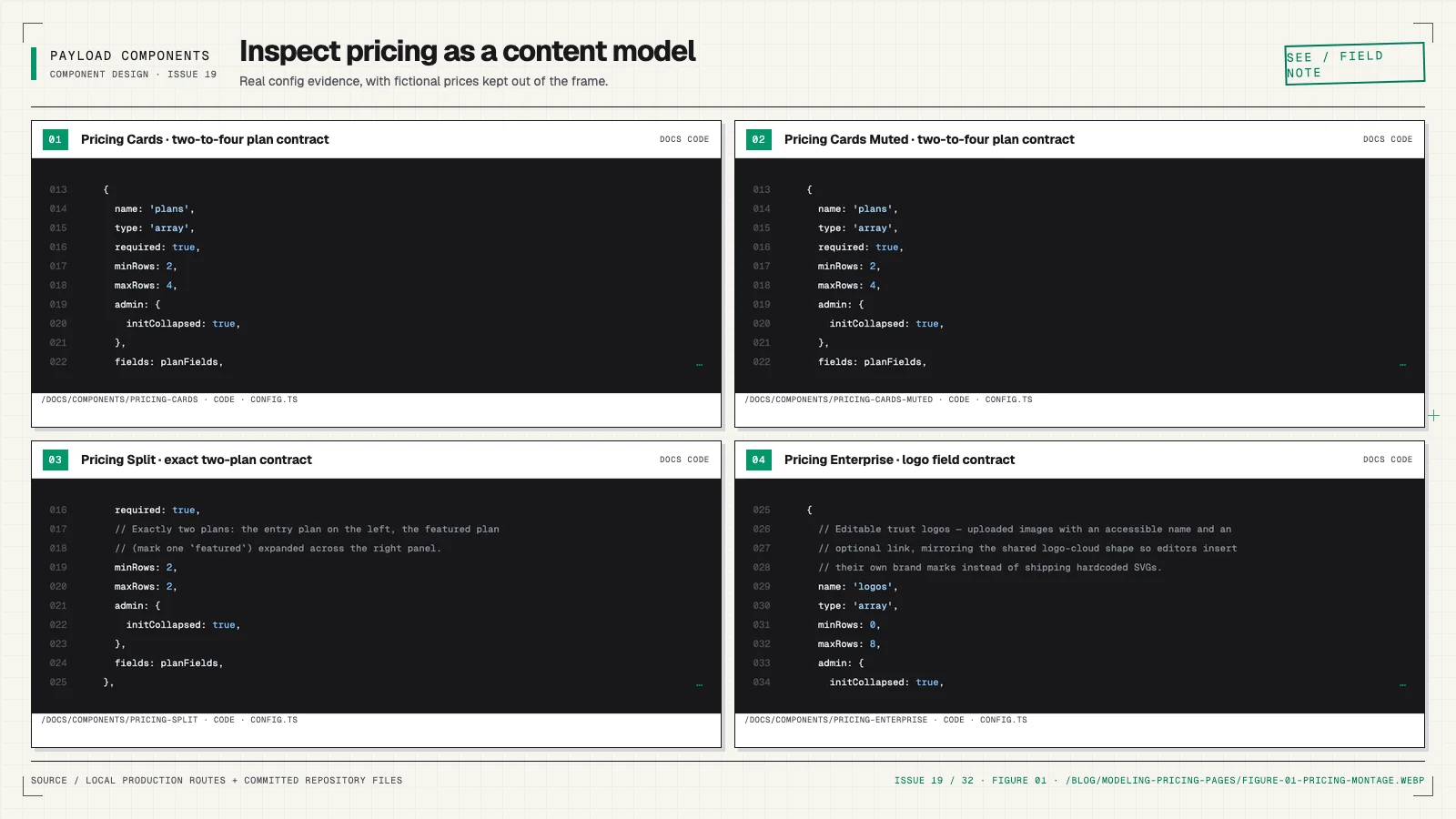
Decide where plan data belongs
If plan information appears only on one landing page and changes with that page, an array inside the pricing block may be sufficient. If the same plans power checkout, account entitlements, multiple pages, or localized product surfaces, use a dedicated collection or another authoritative domain system and reference it.
Do not let a decorative page block become the source of truth for billing. A displayed $29 string
does not establish the amount charged by a payment provider. When commerce is involved, treat the
provider or backend product model as authoritative and use Payload for editorial framing or a safe
projection.
This article focuses on editorial pricing sections. Application-specific billing logic remains outside the component registry.
That boundary also protects preview environments. A designer should be able to render representative plans without creating live billing products, and an editor should be able to revise explanatory copy without changing entitlements. When the frontend needs live values, compose them on the server from a trusted product identifier and the billing system's response. Payload can still provide the heading, comparison language, feature explanations, and destination policy. The public section then shows one coherent projection while each system remains authoritative for the information it owns.
Document that ownership beside the field model. Future maintainers should know which values may be edited freely and which are synchronized or derived.
Model display values honestly
Pricing is not always one number. A plan may show a currency, amount, cadence, qualifier, original
price, or “Contact us.” Storing everything in one price string gives editors flexibility but makes
formatting and accessibility inconsistent. Modeling every monetary edge can overfit a marketing
block to commerce logic.
Choose a contract based on the site. A simple editorial model can use:
{
  name: 'plans',
  type: 'array',
  fields: [
    { name: 'name', type: 'text', required: true },
    { name: 'description', type: 'textarea' },
    { name: 'price', type: 'text', required: true },
    { name: 'priceSuffix', type: 'text' },
    { name: 'features', type: 'array', fields: featureFields },
    { name: 'link', type: 'group', fields: linkFields },
  ],
}
Labels and descriptions should clarify that values are display copy, not billing configuration. If structured money is required, model currency and amount with validation and format them through a shared utility.
Keep comparison claims maintainable
Feature lists need consistent granularity. One plan should not list “Everything you need” while another lists seven technical capabilities. Give every item a concise label and optional context.
For a small number of cards, per-plan arrays are easy to edit. For a strict comparison table, model features as rows with a value per plan so the relationship remains aligned. These are different content structures and often deserve different blocks.
Avoid storing arbitrary checkmark HTML. Use a controlled value such as included, excluded, limited, or a short text value. The renderer can provide the accessible phrase and visual icon. Screen readers need more than color or a bare check glyph to understand availability.
The component catalog shows current card, split, and enterprise-oriented structures. Choose from what is actually shipped rather than building one schema with a dozen layout toggles.
Make emphasis constrained
Many pricing sections highlight one plan. A boolean featured field on every plan allows zero,
one, or many featured cards. If the design assumes exactly one, validate that invariant or model the
highlight at section level as a selected plan reference.
The content meaning should be “recommended plan,” not “emerald border.” The component decides how recommendation appears through tokens, ordering, badges, and responsive layout.
Be cautious with claims such as “most popular.” If the label is not based on evidence, it can erode trust. Give editors a neutral optional badge and establish review ownership for time-sensitive claims.
Treat actions and destinations as a trust boundary
Pricing actions often lead to signup, checkout, contact, or documentation. Use a shared link model that distinguishes internal references from external URLs. Validate allowed protocols and render links as links. Do not allow arbitrary script URLs or raw HTML through a convenience text field.
If an action creates a checkout session, the client should call a trusted server endpoint that maps an allowed plan identifier to backend product configuration. Never accept a CMS-provided amount as the amount to charge.
The safe links, forms, and embeds guide covers validation and server boundaries in more detail.
Choose a structural variant deliberately
The pricing family includes structures such as pricing-cards, pricing-cards-muted,
pricing-cards-cta, pricing-split, and pricing-enterprise. Their differences are not merely
color. They allocate hierarchy differently: equal plans, a quiet treatment, a prominent action,
editorial split content, or enterprise context.
Keep those as suffixed registry items with explicit schemas and previews. Shared field definitions can preserve plan vocabulary, but each variant should declare the requirements its React structure actually needs. The variant design article explains the boundary.
Do not expose the item name as a runtime dropdown in one universal block. The catalog is the better selection interface because it shows the structure before installation.
Plan for localization and legal review
Currency format, cadence, tax language, cancellation claims, and feature availability vary by market. Use Payload localization where the editorial team can support it, and keep locale-specific pricing logic explicit. A translated currency symbol is not necessarily a converted or valid local price.
Give legal or product reviewers a predictable field model and versions workflow. Time-sensitive claims need ownership and review dates outside the component itself. The block should make copy easy to update without pretending it can govern business policy.
Avoid baking temporary campaign language into source. Put the text in fields, constrain it through the design, and schedule publication through the Page collection's normal draft workflow.
Test awkward plan sets
A three-card desktop screenshot is only one state. Test:
- one plan and two plans;
- four or five plans at desktop and mobile widths;
- a long plan name and multi-line price suffix;
- no recommended plan and a validated single recommendation;
- unequal feature counts;
- text values instead of checkmarks;
- a missing optional action;
- localized copy with longer words;
- keyboard focus and zoomed text.
Cards should grow without clipping, and DOM order should match reading and focus order. A horizontal comparison may need an accessible scroll container and visible affordance on narrow screens. Do not shrink text until a dense table technically fits.
Keep the frontend source adaptable
Installed components preserve optional wrapper props and use design tokens. Adapt the plan model to your domain after installation. If plans live in a collection, replace the inline array with a relationship or server-composed projection. If checkout requires authentication, integrate it at the application boundary.
Start with the structure closest to the page's editorial job:
npx payload-components add pricing-cardsReview the pricing component docs, enter actual plan content, and test the non-ideal states before publishing. If a repeated pricing structure is missing, propose it through the contributing guide with its content model, responsive behavior, accessibility rules, and distinction from existing variants. A useful registry family grows from real plan structures, not from collecting cosmetic permutations.