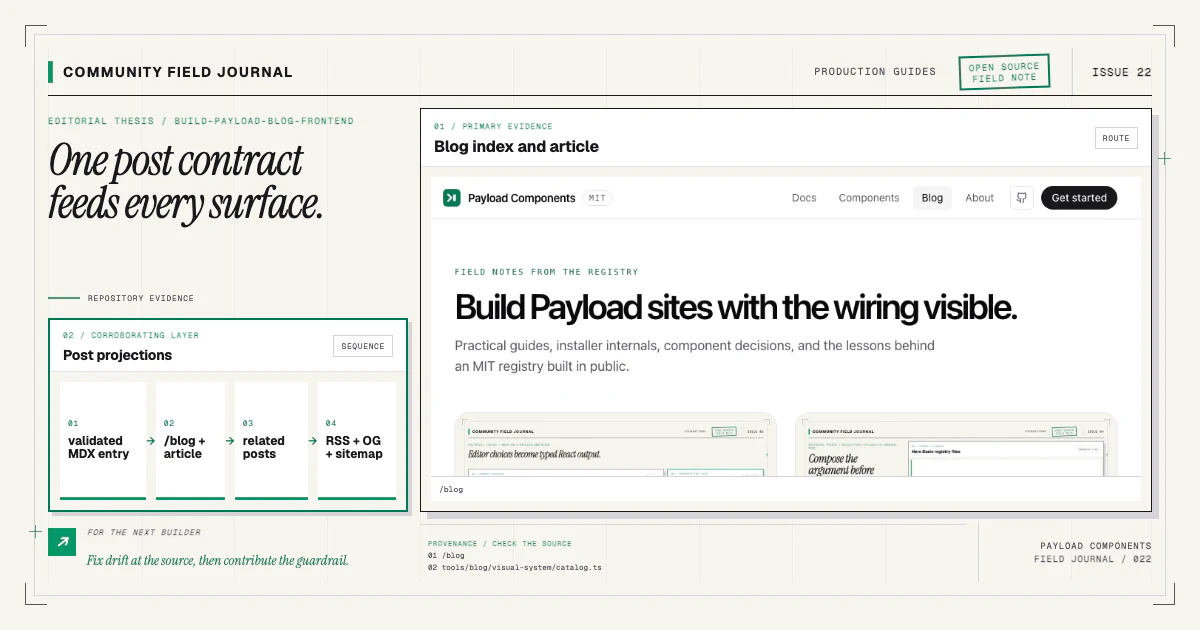
A blog frontend is more than an article template. One editorial record feeds the index card, article route, related content, canonical metadata, social image, sitemap, and RSS item. If each surface invents its own interpretation, titles drift, draft content leaks, images break, and a schema change becomes a repository-wide hunt.
I start with an editorial contract, then build every projection from it. In a Payload-backed application, Payload owns structured content and publishing state. Next.js owns routing, rendering, metadata, and caching. Post components own reusable presentation without becoming a second source of truth.
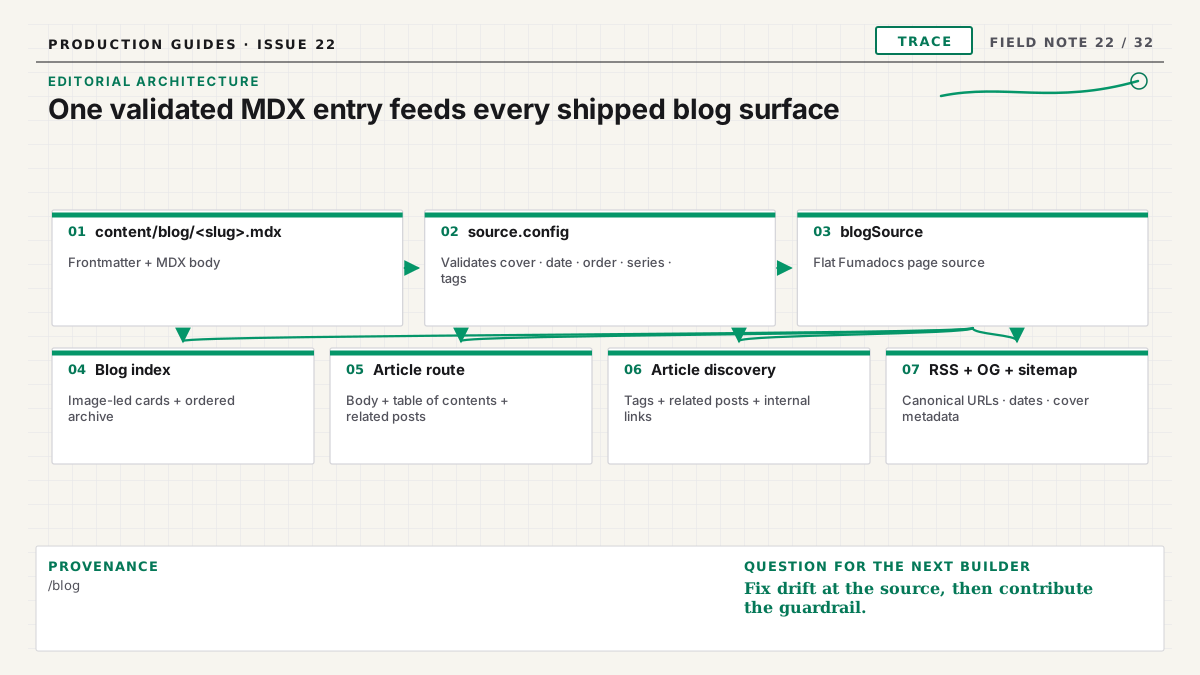
This repository demonstrates that contract with an MDX-backed blogSource. The /blog route renders
all article cards on one index, related posts are derived deterministically, and the same validated
entry feeds RSS, Open Graph, and sitemap output. There is no blog pagination or blog search; the
existing search endpoint belongs to the documentation surface.
Model the Post before the page
A practical Post collection includes:
- title and unique slug;
- concise description or dek;
- publication date and optional updated date;
- author relationship or controlled byline;
- hero image with alt text;
- rich article content;
- tags or categories with a defined purpose;
- SEO overrides only where editorially necessary;
- drafts, versions, access, and preview configuration.
Decide which fields are required to publish, not merely required to save a draft. A draft may begin without a hero image. A public post should not emit an empty social card. Payload hooks or workflow can validate the publish transition according to the application.
Use a stable slug and establish redirect behavior before editors can rename it casually. A published URL is an external contract referenced by feeds, search engines, and other sites.
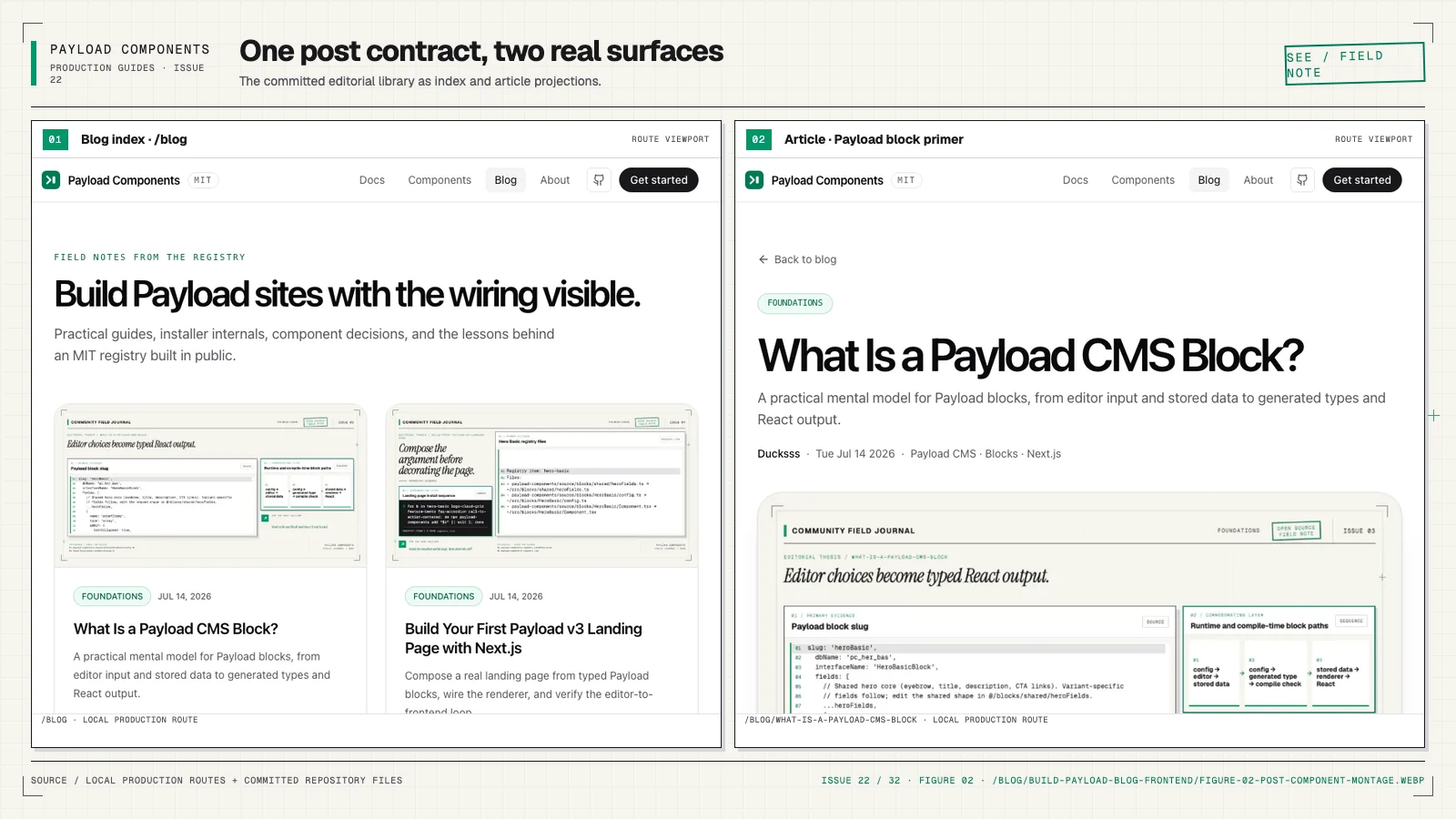
Separate rich content from page blocks
An article body and a marketing page have different editing rhythms. Rich text is appropriate for headings, paragraphs, lists, code, quotations, and inline media. Blocks are appropriate for structured interruptions whose fields and rendering deserve an explicit contract.
Avoid making every paragraph a block; it slows writing and fragments semantics. Avoid accepting raw HTML for every special case; it weakens validation and rendering safety. Define a restrained set of article-specific blocks only when the content cannot be represented clearly through the rich-text editor.
If block data appears inside rich content, generate types and render discriminators through an explicit map just as you would for a Page layout. The Payload block primer explains that lifecycle.
Fetch only publishable content
The public route should query by slug, published status, locale, and access context. Preview mode can use draft content through a separate authenticated path. Do not fetch with elevated access simply because server code can.
When a Payload Local API operation passes a user, set overrideAccess: false so the supplied user
actually participates in access control. Pass the request object to nested Payload operations inside
hooks. Those details prevent server convenience from bypassing the policy the collection declares.
Choose relationship depth deliberately. Author and media fields may return IDs or populated documents. Type-narrow those values. A type assertion does not populate a relationship.
Build the index as a projection
The index needs title, description, slug, date, hero thumbnail, tags, and perhaps author. Query and select only those fields when the application benefits from reduced data. Sort by the publication contract, not database creation time.
Cards should use semantic article markup and one clear heading link. Avoid nested links around tags or actions. Reserve image dimensions, provide useful alt text or an empty alt when the adjacent title duplicates the information, and test long titles.
At this repository's corpus size, one complete index is simpler than client filtering, so /blog
renders all cards without pagination. A substantially larger Payload-backed publication may instead
use server pagination with stable canonical URLs. Do not ship every full rich-text document to the
browser just to derive a card excerpt.
Render the article with stable chrome
The article page should expose one h1, description, byline, publication date, tags, cover, body,
and related content. Put navigation and editorial metadata outside the rich-text renderer so an
editor cannot accidentally create a second page title.
Generate an inline table of contents from body headings when the article is long enough. IDs must be deterministic, unique, and shared between heading output and navigation links. Preserve logical heading order; visual typography should not dictate semantic level.
Figures need a reusable component with required alt text and visible caption. Code blocks need horizontal containment on narrow screens. Tables should scroll within their own region rather than forcing page overflow.
Derive metadata from the same record
Set the canonical URL from the stable slug and configured site origin. Use title and description from the Post unless explicit SEO fields override them. Attach a post-specific social image with fixed dimensions. Next.js documents current metadata file conventions and route metadata behavior.
Emit BlogPosting JSON-LD with headline, description, author, publication date, tags, canonical URL,
and image. Follow Next.js's current JSON-LD guidance,
including safe serialization that prevents raw < from creating script markup.
Structured data is another projection, not a place to invent missing claims. Its date and author should match visible article chrome.
Add RSS and sitemap deliberately
An RSS route can be a small server handler without another dependency. Escape XML values, use canonical URLs as GUIDs, include publication dates, descriptions, and image enclosures, and return an appropriate XML content type. Decide whether the feed includes full content or summaries; summaries keep the route simpler and avoid rich-content serialization surprises.
The sitemap should include every public post URL and publication or modification date according to the site's convention. Drafts must not appear. Tests can compare the number and slugs in blog data, RSS, and sitemap so one surface does not silently drift.
For this repository's editorial implementation, the blog index and RSS link are discoverable from the site and AI text surface while the full documentation corpus remains separate.
Define related posts without randomness
Related content should be deterministic. Use shared series or tags, exclude the current post, and apply stable date or editorial ordering. Random results make caching and tests noisy and can surface old irrelevant content.
Limit the section to a useful number, usually three. Cards should carry enough context to explain the relationship without repeating an entire index. If the taxonomy has no credible matches, omit the section rather than filling it with arbitrary posts.
For a Payload-backed site, compute relationships at request or build time from selected metadata, or materialize them explicitly when editorial control matters. Avoid a client-only fetch that delays the last meaningful navigation on every article.
Make previews and cache invalidation honest
Editors need to preview drafts without making them public. Use authenticated draft mode and a clear visual indicator. The public cache should only contain publishable results.
When a post publishes or its slug changes, revalidate the article, index, related pages, sitemap, RSS,
and any tag archives affected. A hook that triggers nested Payload operations must pass req, and a
hook-driven update that could reenter itself needs a context flag to prevent loops.
Document the invalidation graph. “The article updated but the homepage card did not” is usually a projection or cache dependency that was never made explicit.
Test the whole editorial system
Create fixtures for draft, published, long title, missing optional image, multiple tags, populated and
unpopulated author relationships, rich figures, tables, and code. Browser tests should walk every
public post and assert canonical metadata, one h1, cover response, figure captions, JSON-LD, related
content, and no horizontal overflow.
Validate RSS as XML and assert unique canonical GUIDs in deterministic order. Request every social image and check its dimensions. Include representative index and article routes in accessibility and visual coverage.
The visual regression guide explains how stable capture routes and coverage guards keep a growing presentation surface honest.
Start from owned source
The registry's post-component collection is still an explicit, source-owned surface: install only items shown as available in the current catalog, and wire them to your Post contract rather than copying fictional commands from an article. For page sections around the blog, you can start with a real call to action:
npx payload-components add call-to-action-centeredThen adapt the installed fields and component to the editorial architecture above. If you contribute a post component, ship source, manifest where Payload wiring is required, registry entry, docs, preview, and tests together through the contributing guide. A polished card is useful; a coherent editorial projection across routes, metadata, feeds, and access is what makes it production-ready.